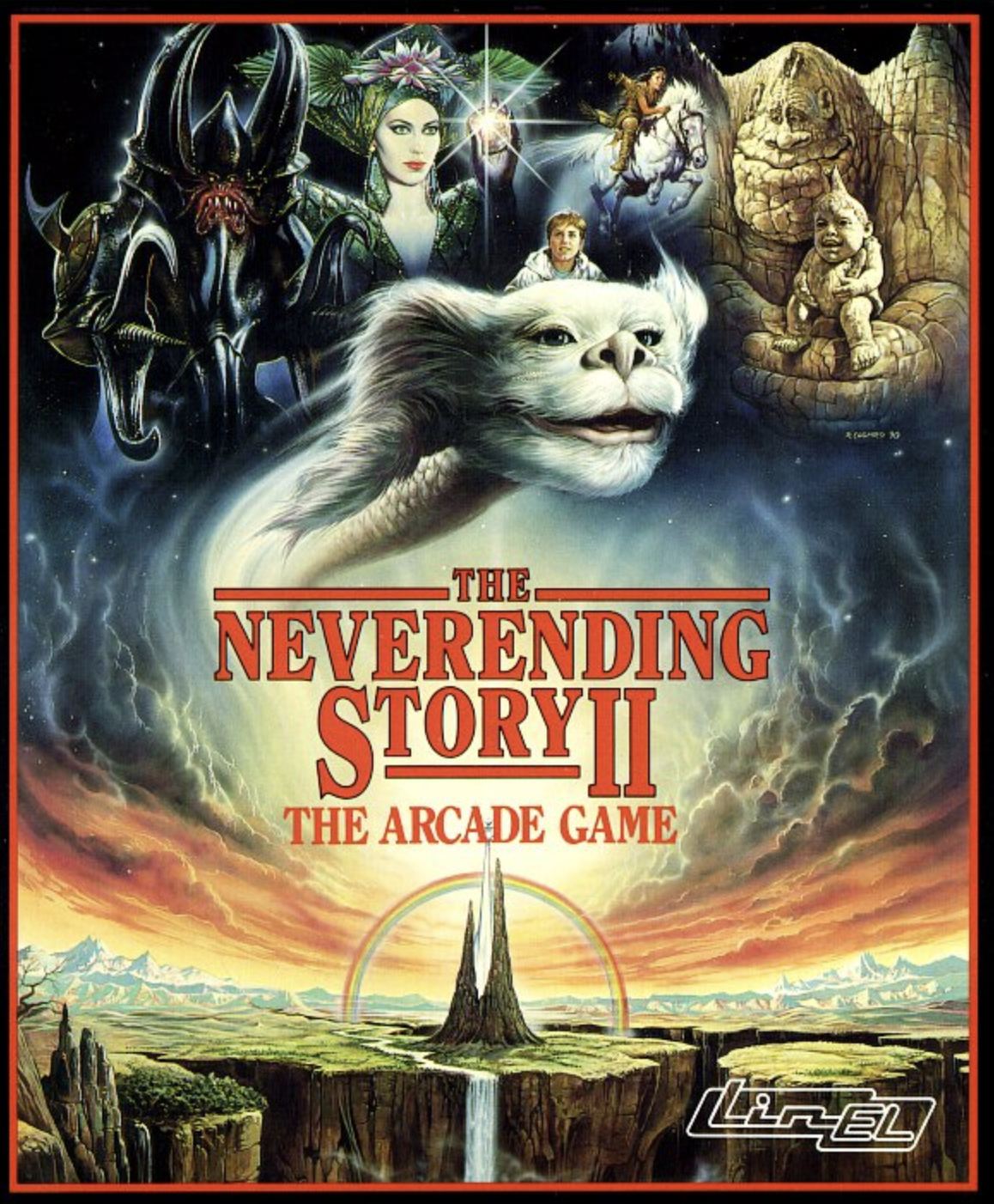
The Never Ending Story II, the Arcade Game is a jump-and-run platform game distributed by Linel. It belongs to the action-adventure genre, specifically the 2D action-adventure subcategory, and was released on January 1, 1991. The game is largely based on the film of the same name.
Game description
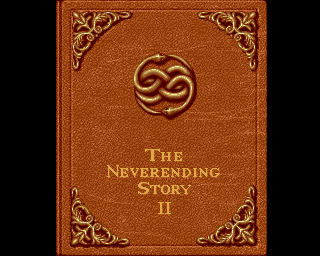
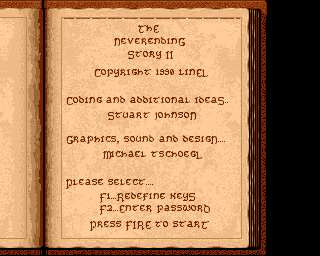
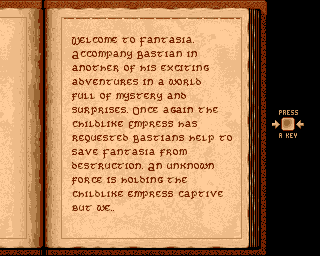
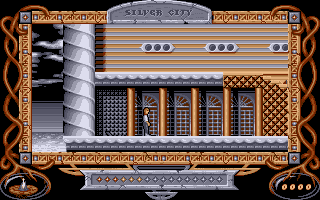
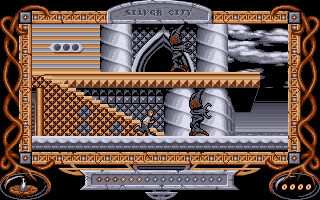
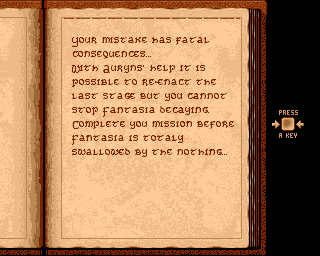
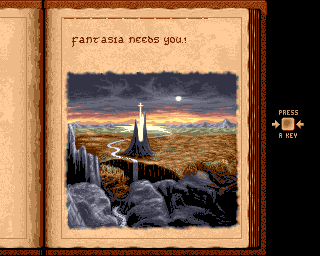
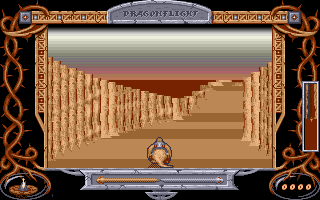
The player takes on the role of Bastian and is once again summoned by the Childlike Empress to save Fantasia, the Land of Dreams. The player progresses through various action scenes, such as running through the Silver City or riding on Falkor, with dexterity and memorization of level paths being the main focus. As in the film, the player must also escape from giants or push them over ledges. With each level, the story advances further, usually presented in the form of a few pages written in a “book.”
Translations and Plattform
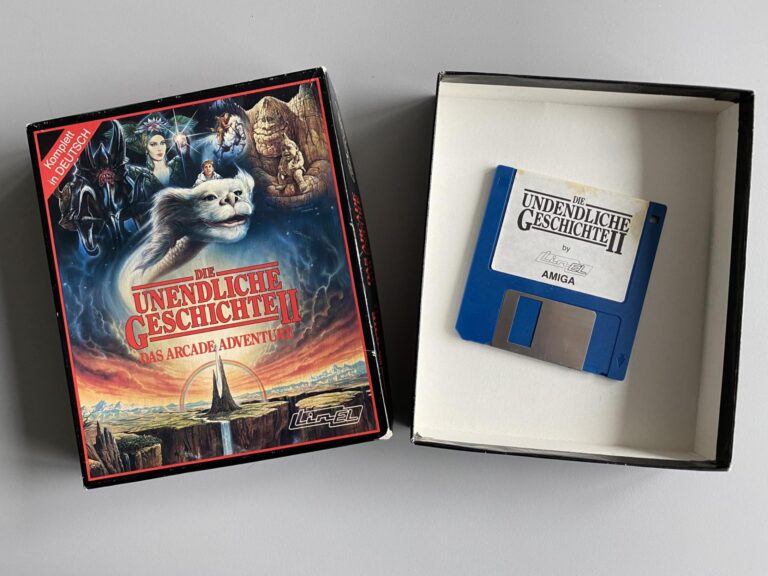
The release of Neverending Story II: the Arcade Game in early 1991 in German on Commodore 64 was followed by Amiga, Atari ST and PC versions in French, Italian and English and Spanish.In the Italian version Andy Routledge was involved for storyboard and Emilia Urso for text translation.
- German: Die unendliche Geschichte II – das Arcade Adventure
- English: The Neverending Story II – the arcade game
- Italian: La Storia Infinita II
- Spanish: La Historia Interminabile II – Arcade I
Game reviews
„The game didn’t receive very good reviews. For example, in Amiga Power issue 10 (February 1992), Jonathan Davies wrote:“...I’m afraid I simply didn’t have the patience to slog it through screen after screen of identical platforms and staircases…” Further review source: Amiga Action 30 (Mar 1992), Amiga Power 10 (Feb 1992), Datormagazin Vol 1991 No 10 (May 1991) The game is considered very difficult, as a single mistake often leads to immediate death and requires a great deal of trial and error.
LINEL, The Neverending Story, and the Challenges of Game Development in Switzerland
LINEL was a software developer and publisher based in Switzerland, active from 1987 to 1995. The company aimed to establish itself as a recognized development label but faced several challenges during this period. At the time, many games in Switzerland were being hacked—not only within local hacker communities but also by international companies.
Publishing games in Switzerland also proved to be financially difficult, as there were no investors willing to take risks in a sector unfamiliar to them. As Markus Grimmer recalls: “When we made The Neverending Story II, I was very lucky that the company Merimpex from Liechtenstein wanted to invest. They had previously invested in a smaller game, and they got back much more than they had anticipated” (Markus Grimmer in conversation with Beat Suter 2024d)
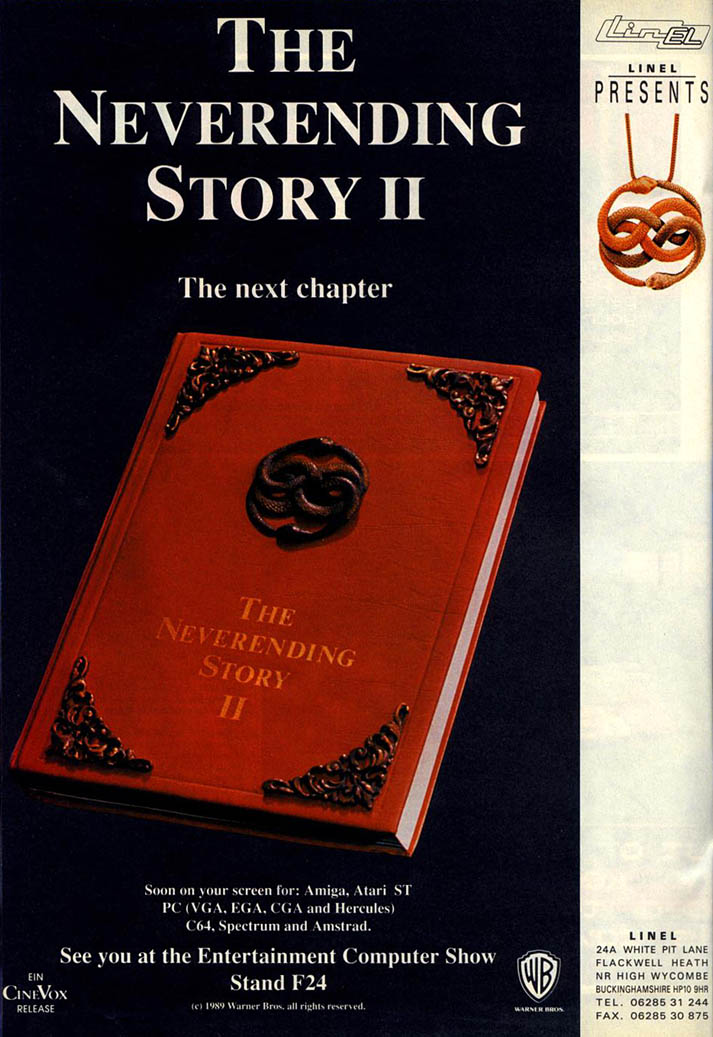
In 1990, LINEL acquired the licenses for The Neverending Story for Europe and Asia, while Merit Studios purchased the rights for the American market. As Markus Grimmer explains, the licensing conditions differed significantly: “For Europe, the license was extremely expensive at the time. In America, people didn’t know the movie that well, so the license was relatively cheap. Merit Studios got it for $30,000.” The American company distributed LINEL’s game on the C64, Atari ST, Amiga, and PC platforms. In Europe, LINEL expanded the release by adding CPC Schneider and ZX Spectrum versions, allowing the game to be marketed across all six major computer platforms available at the time. “This was the only game we made for all platforms,” Markus Grimmer notes (ibid.).
At one point, a Taiwanese company expressed interest in purchasing licenses from LINEL even before at least two of its products—including The Neverending Story—had been officially released (ibid.). However, despite its initial intentions, LINEL ultimately did not make full use of the licenses it had acquired.
The Unreleased Follow-Up: The Neverending Story II – The Adventure
In addition to the arcade game, LINEL planned a second installment titled The Neverending Story II – The Adventure, intended as the starting point for a broader adventure series. As Markus Grimmer recalls, the project initially showed promise: “We had a good relationship with Peter Geissler, the producer [likely referring to producer Dieter Geissler]. He told us to start right away and wanted to provide us with material” (ibid.).
The game was to be developed using the new MACS engine (Modular Adventure Control System), created by Arndt Hasch for LINEL as a response to LucasArts’ SCUMM engine. A demo version was completed and presented in PC Joker (issue 6/91), where reviewers praised its graphics and especially its sound, noting similarities to the point-and-click interface of SCUMM-based adventures. Despite this positive reception, the game was never finished.
The project ultimately failed due to licensing issues. At the time, the US film studio Warner Bros. had contracted Entertainment Munich to manage film licenses, and according to Markus Grimmer, the company demanded extremely high fees. Since LINEL had already paid around 100,000 Swiss francs for the arcade game license, the company was unwilling to commit to an even more expensive second license. Negotiations therefore broke down.
Despite these challenges, LINEL maintained a good relationship with the author Michael Ende, who was interested in computer games and contributed ideas to the project (ibid.). Reflecting on the financial outcome, Markus Grimmer noted: “I would say we came out with a red zero. It wasn’t the success we were hoping for. That’s why we never bought another big movie license” (ibid.).
Sources:
https://research.swissdigitization.ch/?p=613
,
https://chludens.hypotheses.org/2743