ClickOMania
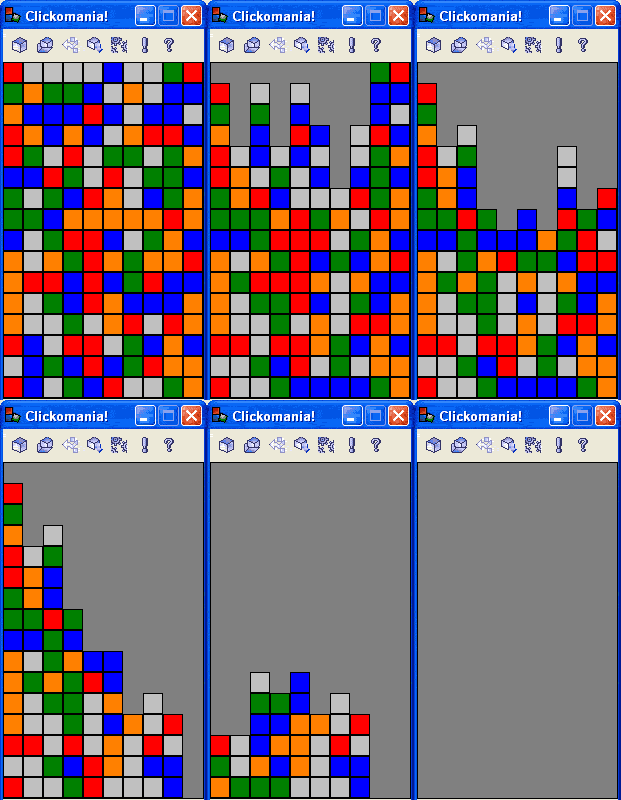
ClickOMania is a casual clicker game developed by Matthias Schüssler as cardware (freeware/shareware) in 1998. The game belongs to the SameGame-likes category. Two or more connected fields can be clicked away (horizontally and vertically). The playing field has gravity and is also pushed to the left. The aim is to clear the playing field as much as possible. The game was designed to be played while working, as a way to relax.
Postcardware: Anyone who liked the game and played it for more than 3 weeks was asked to send a postcard to the developer. Matthias Schüssler received boxes of postcards from all over the world. The game was distributed via freeware/shareware channels: FTP, shareware lists, CD-ROMs, cover CDs for magazines and a website. The game was available in different language versions.
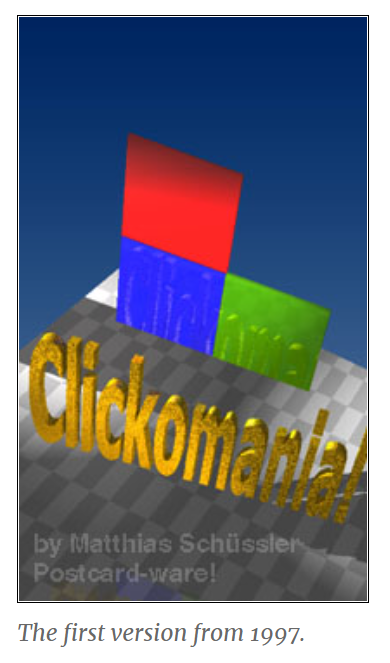
The first version of Clickomania was created over the Christmas and New Year holidays in 1996. Schüssler had previously seen a poorly programmed version of the game SameGame (possibly an online version) for marketing purposes. With his first version, he also wanted to see if he could technically implement the whole thing. In doing so, he wanted to go further than the original.
As far as is known today, the game mechanics trace back to the 1985 game ChainShot by Kuniaki Moribe. However, Schüssler only learned this with the advent of Wikipedia. The name says it all: ChainShot is a type of cannon ammunition consisting of two hemispheres connected by a chain, which breaks apart upon firing and spins, destroying everything around it. In this case, that means adjacent colored tiles. In the game, you move a cursor over a given color grid and look for at least two adjacent color fields (horizontal/vertical). These are then destroyed and collapse downward and to the left until all are cleared or there are no more pairs of fields. The game was then ported to Unix under the more catchy name SameGame. With this, the game’s name moved away from a physical military reference and became more abstract.
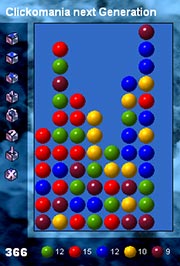
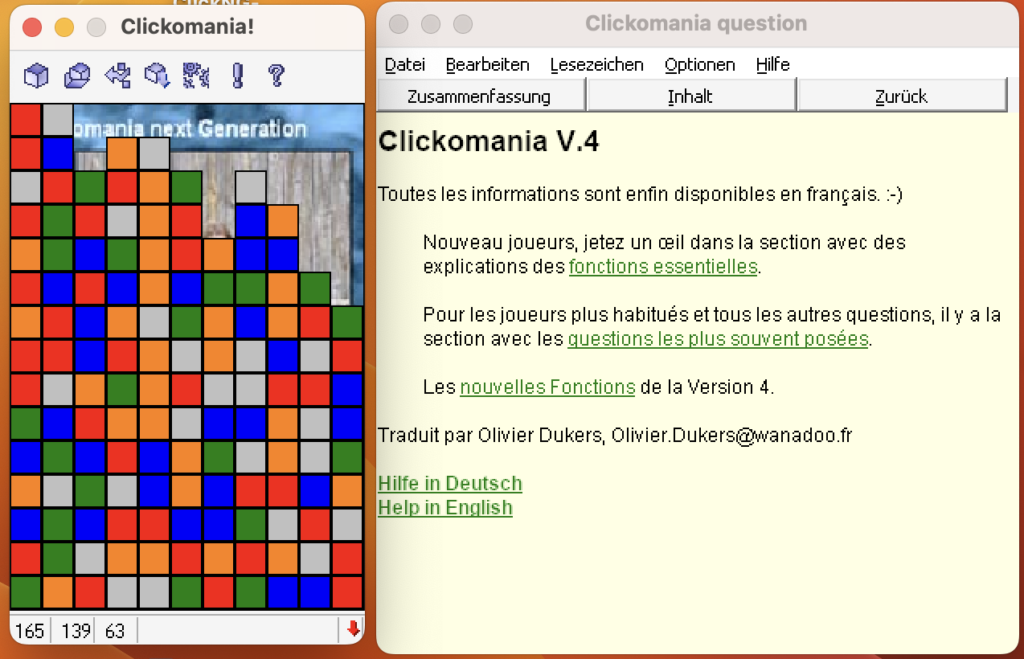
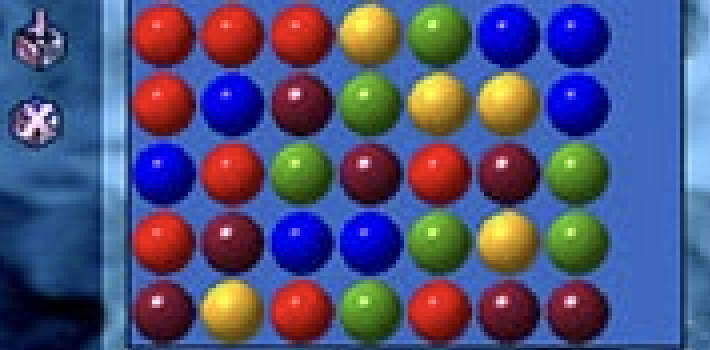
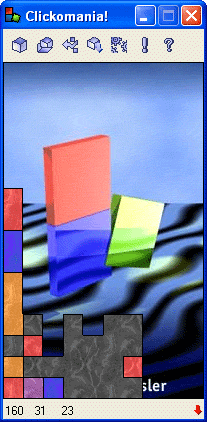
The design of ClickOmania has changed over time. At first, the “stones” were 2D and only later became spheres, and in the end, it was customizable. In an interview, René Bauer asked Schüssler, why did he use spheres?
Schüssler’s answer: „At first, they were angular. There were different types of fields. But I thought the spheres were beautiful. I then used Corel 3D—I was able to render the spheres beautifully in 3D. And then it had such a nice 3D look. […] It just looked futuristic. And at first, there was also a 3D background image.“
ClickOmania was what we call a casual game today. Clickomania was designed to be a quick break from work—a brief interlude—and wasn’t meant to be played in full-screen mode. “No, because it’s a casual game. You can keep it open next to your word processor, and if you’re stuck —if you have writer’s block—you can click around on it with one hand, and when you’re done, you can go back to your word processor or Excel."
Since the game was designed to be replayable, it’s no surprise that Clickomania (like similar games) did not have levels. It relied on randomness to generate levels. This was the only way to ensure a fresh gaming experience every time with minimal effort.