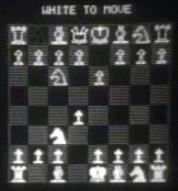
Charly stands for Chess Heuristics and Algorithms for Relaxing Lazy Yodelers. It was an early chess program developed in 1967–1968 by Gerald Tripard, Gerhard Rudolf, and Werner Joho at ETH Zurich.
The program was written in Fortran—short for FORmula TRANslation—one of the oldest programming languages, developed in the 1950s by IBM for scientific and engineering calculations.
Charly ran on a CDC 1604, a mainframe computer built by Control Data Corporation. The CDC 1604 was among the first commercial computers to use transistors instead of vacuum tubes, representing a major step forward in computing technology.
The program’s main tree search examined moves four plies deep. In computer chess, the program evaluates possible sequences of moves to determine the best option. These possibilities can be visualized as a tree: the trunk represents the current position, each branch represents a potential move, and every branch splits further according to the opponent’s responses. The main tree search is the systematic calculation used to identify which sequence of moves leads to the most favorable outcome.
A ply is a move by one player—either White or Black. Looking four plies deep means the program calculates two full moves ahead. In the final position, all possible exchanges on the target square of the last moved piece were carefully evaluated. This made the program tactically strong, although it incorporated very little strategic understanding.
The program’s strategic evaluation included:
- Material advantage: the difference in value between pieces on the board (e.g., Queen = 9 points, Pawn = 1 point).
- Piece mobility: how freely the pieces could move across the board.
- Pawn structure: the arrangement of pawns and their mutual support or weaknesses.
- Pawn advancement toward promotion: how far pawns had progressed toward the opponent’s back rank and their potential to become a Queen (queening).
Considerable development effort went into ensuring that the program played legally according to all chess rules, including castling, en passant, and draws by repetition. The only rule not fully implemented was the ability to promote a pawn to a piece other than a Queen.
The program’s opening book was created by Gerhard Rudolf, the machine language expert. An opening book is a precompiled collection of well-known opening moves that the program can use at the start of a game, saving it from having to calculate these moves from scratch. Most of the opening data came from chess literature, especially the 10th edition of Larry Evans’ Modern Chess Openings.
After further work on both programs, two games were played via amateur radio (Ham Radio) on November 16, 1968. In the second game, both programs were allowed to use their opening books. In the third game, only the ETH program Charly was allowed to use its opening book, while the MIT program had its book disabled—but it still won the game.