CasualGame,Clicker,Puzzle
ClickOMania Next Generations
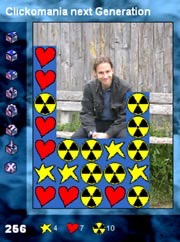
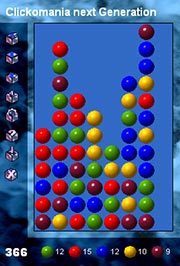
ClickOMania is a casual clicker game developed by Matthias Schüssler as cardware (freeware/shareware) in 1998. The game belongs to the SameGame-likes category. Two or more connected fields can be clicked away (horizontally and vertically). The playing field has gravity and is also pushed to the left. The aim is to clear the playing field as much as possible. The game was designed to be played while working, as a way to relax. The game was distributed via freeware/shareware channels: FTP, shareware lists, CD-ROMs, cover CDs for magazines and a website. The game was available in different language versions. It had various new features such as different game variants, a game designer and a web high score. You could also specify your own image or folder, and it would take the images from it for the background and dynamically adjust the level size.
A little later, “Clickomania NextGenerations” was released. NextGenerations included various new features, such as different game modes, a game designer, and a web high score. You could also select your own image or folder, and the game would use the images from it for the background and dynamically adjust the level size. Schüssler explains: “Clickomania Next Generation was created. It had a game designer [mode]. There, you could customize the game yourself: how many colors, what the game pieces looked like, your own background image.” (Schüssler, Part I, 0:48:15)
This made the game more suited to the capabilities of a modern computer, thereby expanding the gameplay. The idea was also to monetize these features. Schüssler: “The idea [was] to give [the game] away as a marketing or promotional gift. And it was sold. A few dozen copies were sold. […] If I’d had a business partner […], something would have come of it. […] Kagi.com was my sales platform […] Checks. The problem was they were almost impossible to cash. […] It always cost 30%—commission. It was very unattractive.” (Schüssler, Part I, 0:48:15)
Similar problems can also be seen among other shareware developers of that era. Their target audience was the global market, not just Switzerland.
But Clickomania’s motivation went a step further for the developer. Another goal—or motivation—was to experience the “software community.” To see who was playing his game and where in the world. And that was actually possible with shareware, because orders, invoices, and even postcards were often handwritten with greetings and comments. For the developer and the players, it became a kind of OnceOneWay social media platform. “Exactly, when people think it’s cool. When they write postcards. […] Also, getting a sense of the internet. ‘Feeling’ the software community and receiving postcards from all over the world—I thought that was cool. […] The connection without the pressure of being on the same platform.” (Schüssler, Part II, 0:05:00)
The community then, completely unexpectedly, created its own language versions because the DLLs could be customized, resulting in as many as a Chinese version, which Schüssler then integrated.