War Heli
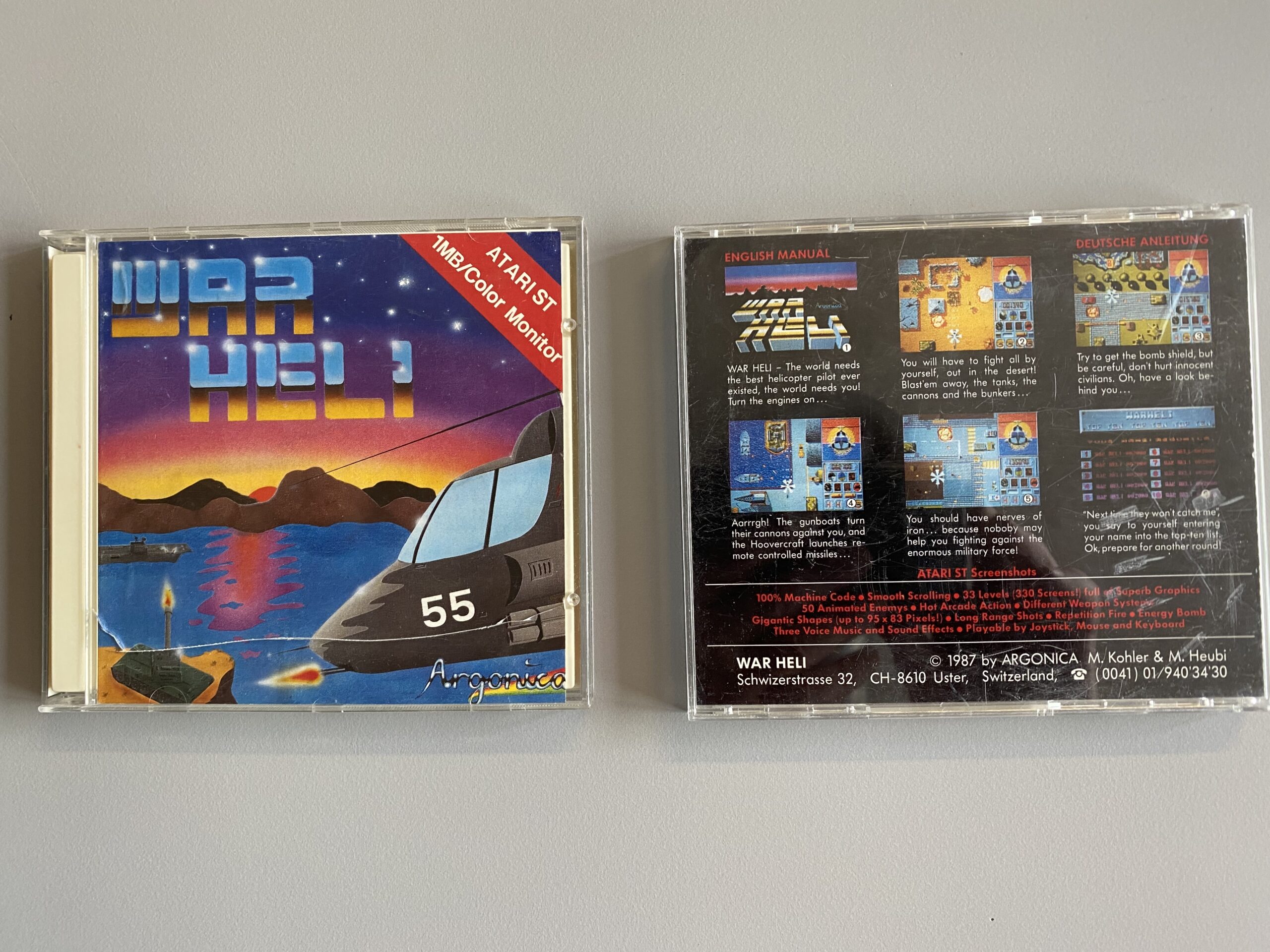
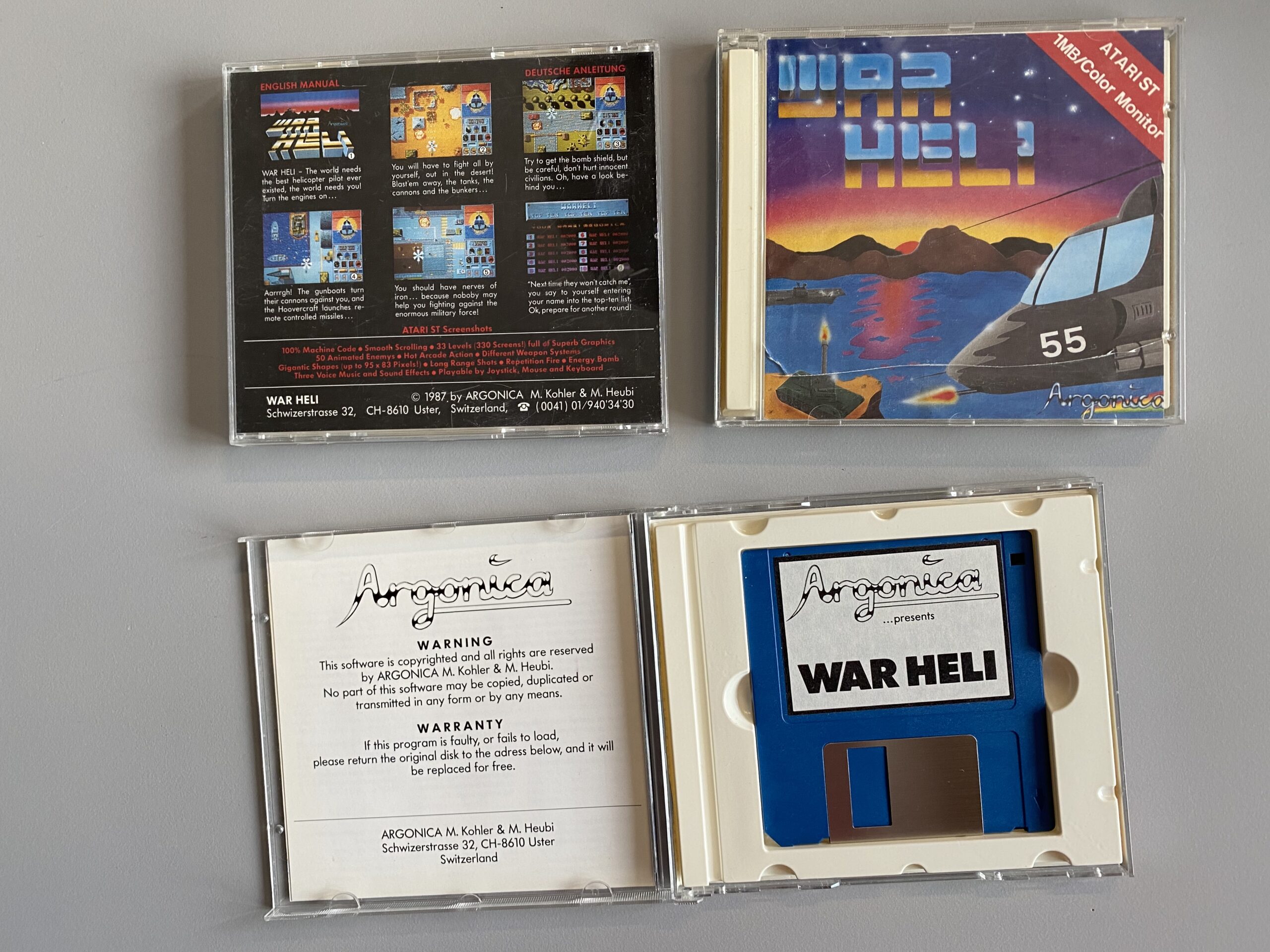
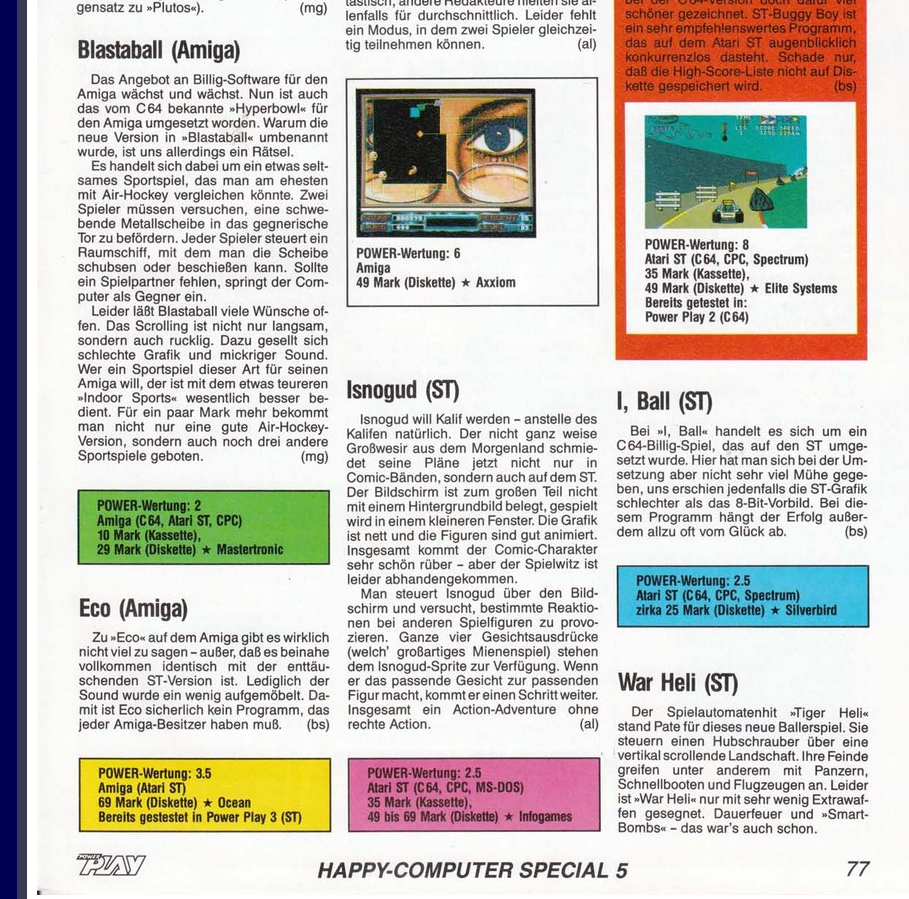
War Heli is a vertically scrolling shooter game developed by Matthias Heubi and Matthias Kohler under their studio name Argonica in 1987. Very few games were created for the Atari, making War Heli a significant exception. It is also exceptional in terms of its international recognition: owing to its virtuosically programmed copy protection, which Heubi (known in the cracker scene as GMC) developed with meticulous care, the game gained a degree of notoriety among crackers and was even featured in "CRACKERS I: The Gold Rush," published by Microzeit Publishing in 2021. Remarkably, however, it is precisely this copy protection barrier that prevented the game — whose level of difficulty would surely have found great favour in the scene — from becoming more widely known. Heubi and Kohler estimate that around 30 to 50 copies were sold. Thanks to a game bundle released by Atari Switzerland, of which War Heli was a part, it can be assumed that this Swiss game found its way into even more Swiss households.
For many who are unfamiliar with the game itself, War Heli is known through Hans-Ulrich Schlumpf and Rainer Trinkler's documentary film "Kap der digitalen Hoffnung" (1989), in which Heubi and Kohler are portrayed as young programmers — albeit with an inaccurate depiction of their respective roles. They serve as an illustration of how digitalization was taking root in living rooms and bedrooms: the computer, at times critically described as a "lifeless," addictive machine, is staged here as a playground for a young generation of tech-savvy men. Heubi had just graduated from high school and Kohler was still a minor, both still living in their parents' homes. This fact underlines the importance of the youth-driven culture of game development in the late 1980s.
The motivation behind War Heli, as Kohler recounts in the CH Ludens interview with Larissa Wild and David Krummenacher, was twofold: first, the challenge of achieving smooth scrolling, and second, the desire to prove that a graphically accomplished game could be created on the Atari ST — not just on the more common and better-equipped rival machine, the Amiga. The primary inspiration was Tiger Heli (Taito, 1985), particularly in level design, enemy projectiles, and overall aesthetics. Blue Max (Bob Polin, 1983) for the Commodore 64, one of Kohler's favourite games — a flight game in which the player pilots a fighter plane over a landscape — also served as a reference point. For the graphics, they used the painting program Degas. The music is two-voiced and syncopated, with melodies that contrast with the typical combat-focused arcade music of games like Tiger Heli and Xevious (Namco, 1983).
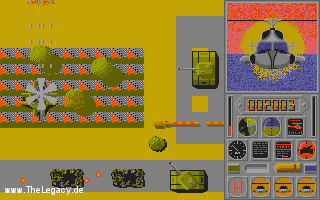
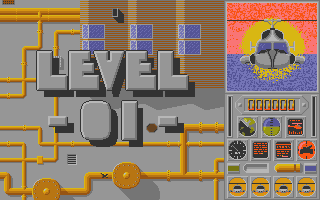
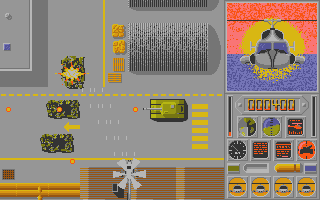
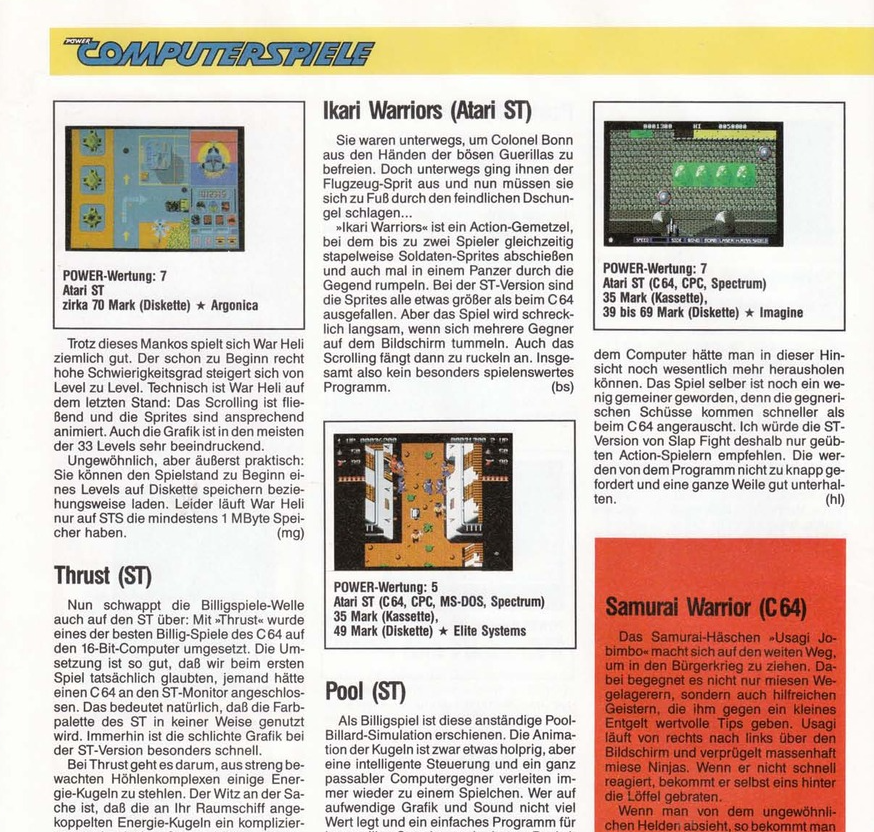
War Heli introduces extended menus and vignette-style cutaways, reflecting the slower pacing and home context of the Atari ST. The cockpit display on the right side of the screen is a result of graphical limitations: Heubi and Kohler pushed the processor to its limits to ensure smooth, glitch-free scrolling, but could only work within a certain screen width. The empty space on the right had to be filled somehow, and the cockpit view was the agreed solution — though it offered little in the way of UI functionality, displaying only the number of bombs and remaining helicopters. A proper UI was provided by the high score entry screen, which Kohler modelled on arcade conventions.
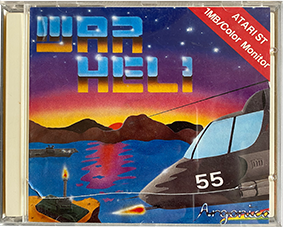
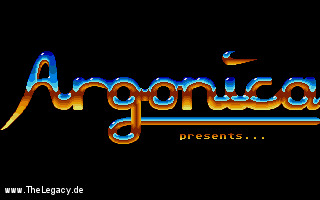
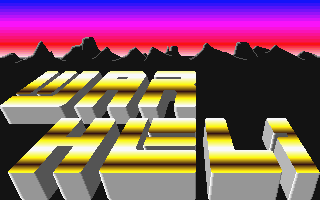
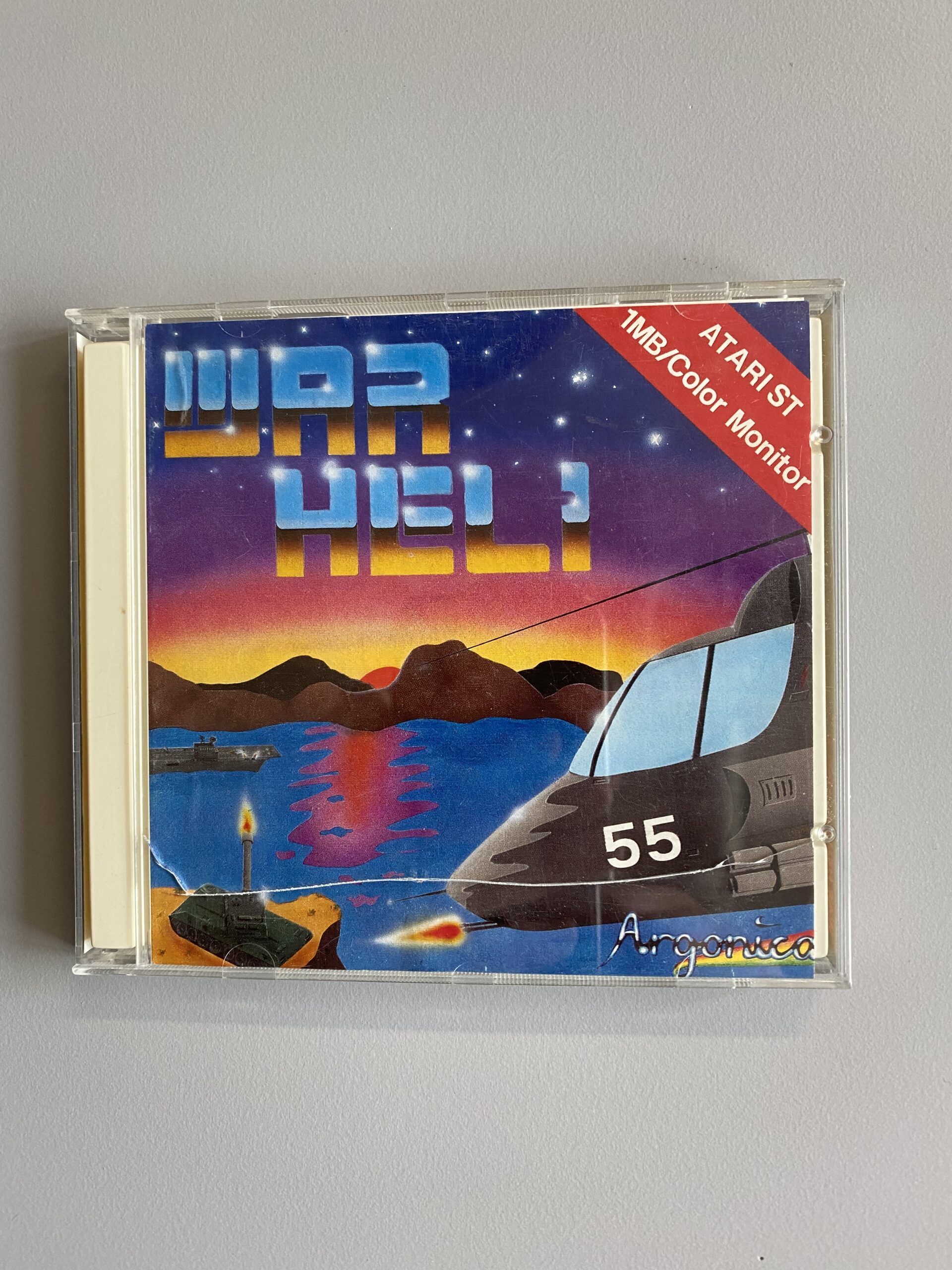
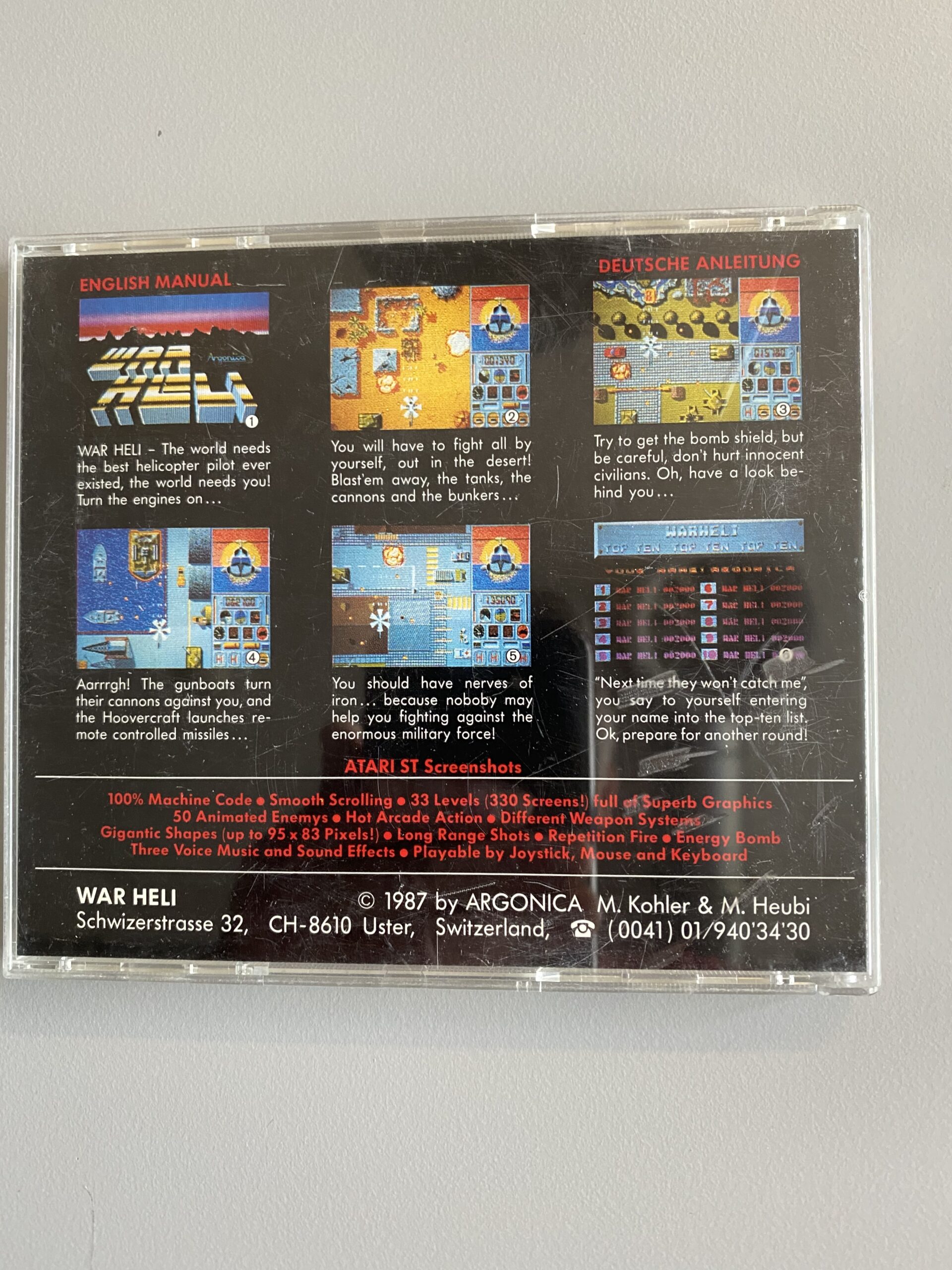
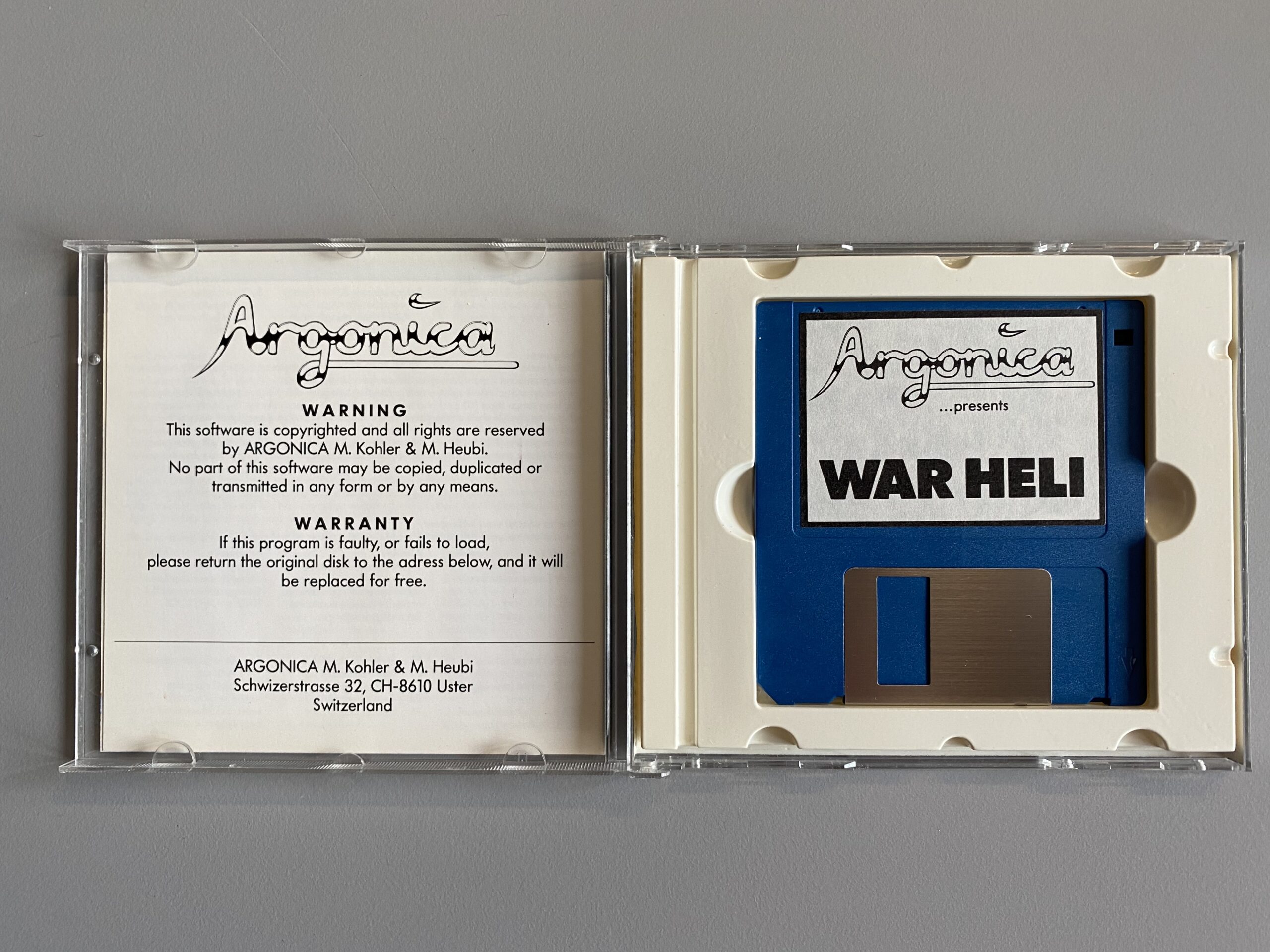
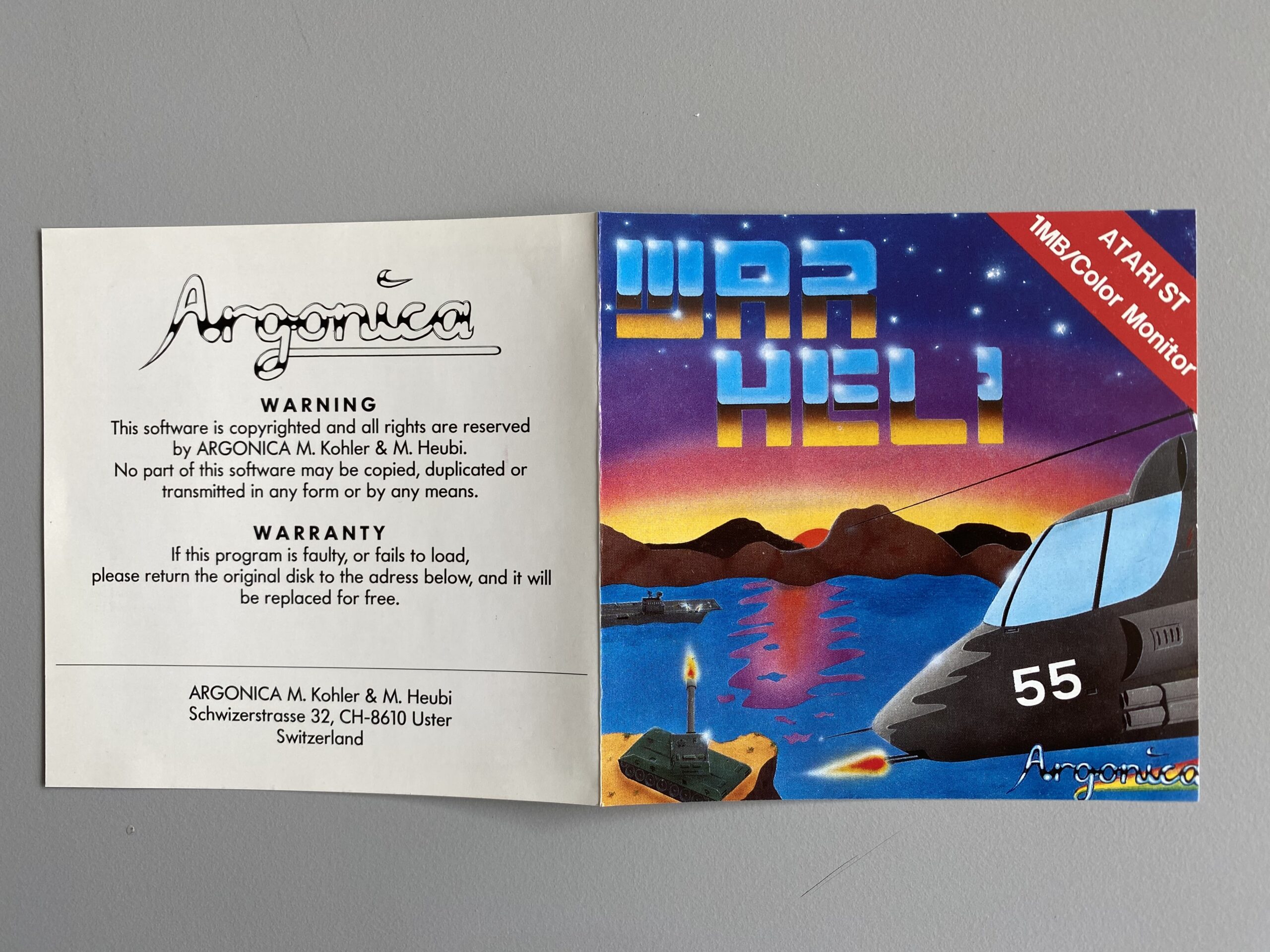
Several people are credited in the title screen. According to Heubi and Kohler, however, the bulk of the programming, graphics, and sound work was carried out by the two of them. Some of those listed are school friends who contributed individual sprite designs or assisted with the music. Others are members of the CAC Club (a club for computer enthousiasts), including I. Zivalic, who in all likelihood drew the river. The influence the CAC Club had on these young programmers is illustrated by the fact that Heubi and Kohler recall first hearing sampling on the Commodore 64 through the otherwise rather ridiculed game Mission Impossible (Dennis Caswell, 1984). Their desire to incorporate sampling — via an interface directly connected to the Atari — could only be realized at the very beginning of the game in the intro sequence, where Heubi performed the title, due to the technical limitations of the hardware. One interesting detail concerns the distribution: after attending their first trade fairs, Heubi and Kohler decided to sell the game themselves, going so far as to create their own packaging — a CD with an inlay — which was unusual for a time when game boxes were the norm.
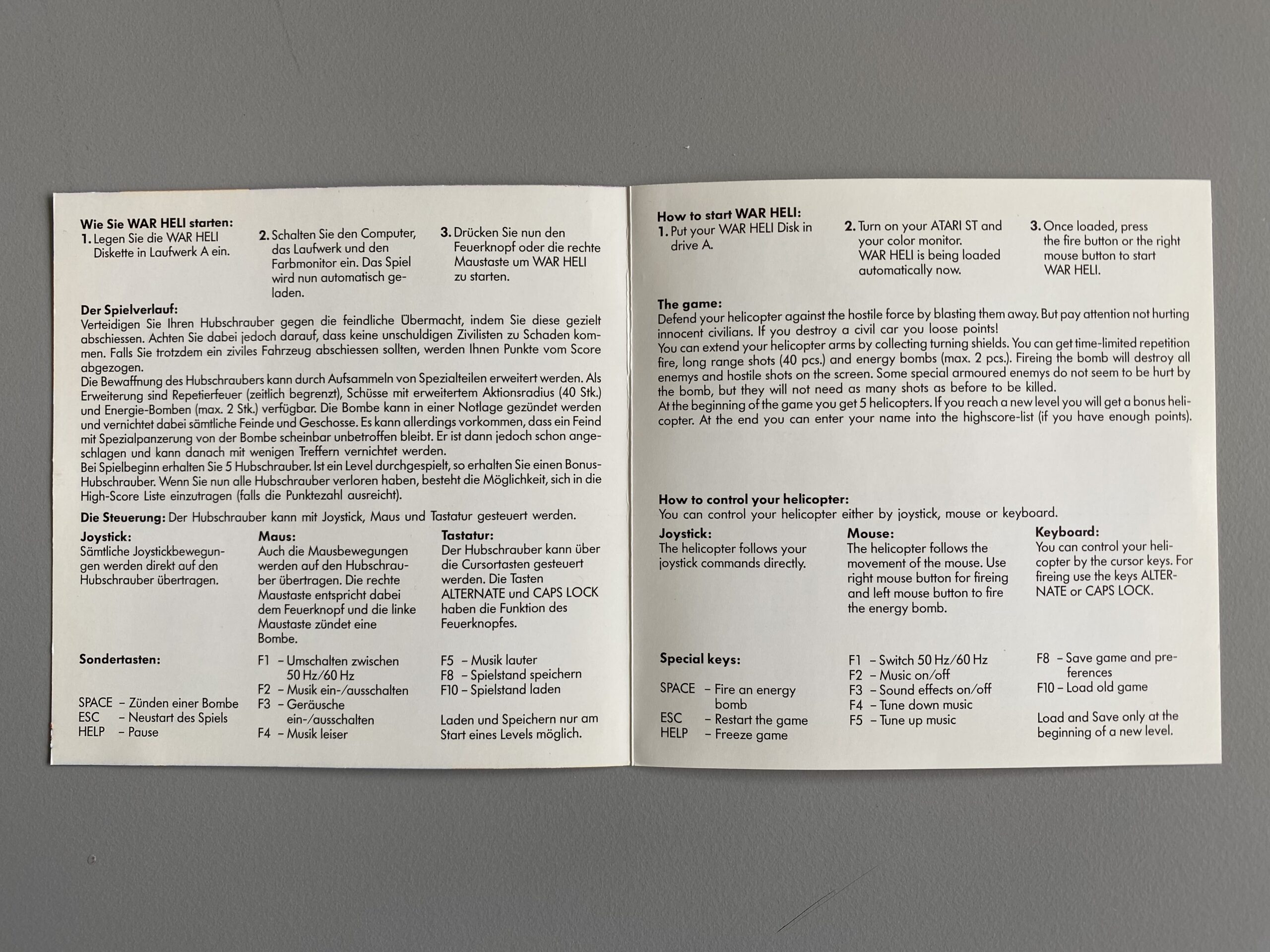
The player begins with a top-down view of an industrial landscape, entering the screen from below in a manner reminiscent of Tiger Heli. Five helicopters are available; deaths roll the player back to the last checkpoint with a bounce effect, adding both feedback and challenge. Basic ammunition is unlimited, while special weapons like bombs appear sporadically, mirroring the collectible mechanics of contemporary games like Super Mario Bros. (1985). A key social mechanic prohibits the destruction of civilian vehicles — targeting ambulances, for instance, incurs maximum point penalties. This, as Kohler admits in the interview, stemmed from a guilty conscience about the war theme, which set in late enough in production that at least a moral component could still be incorporated. The game is notably difficult, with even the initial levels requiring several minutes to complete. This difficulty — much like the extreme copy protection — reflects Heubi's (aka GMC's) challenge-driven mentality, which also includes deliberately frustrating moments such as the bounce effect when the player is hit. The developers themselves admit that they would today struggle to get much beyond the first few levels of War Heli.