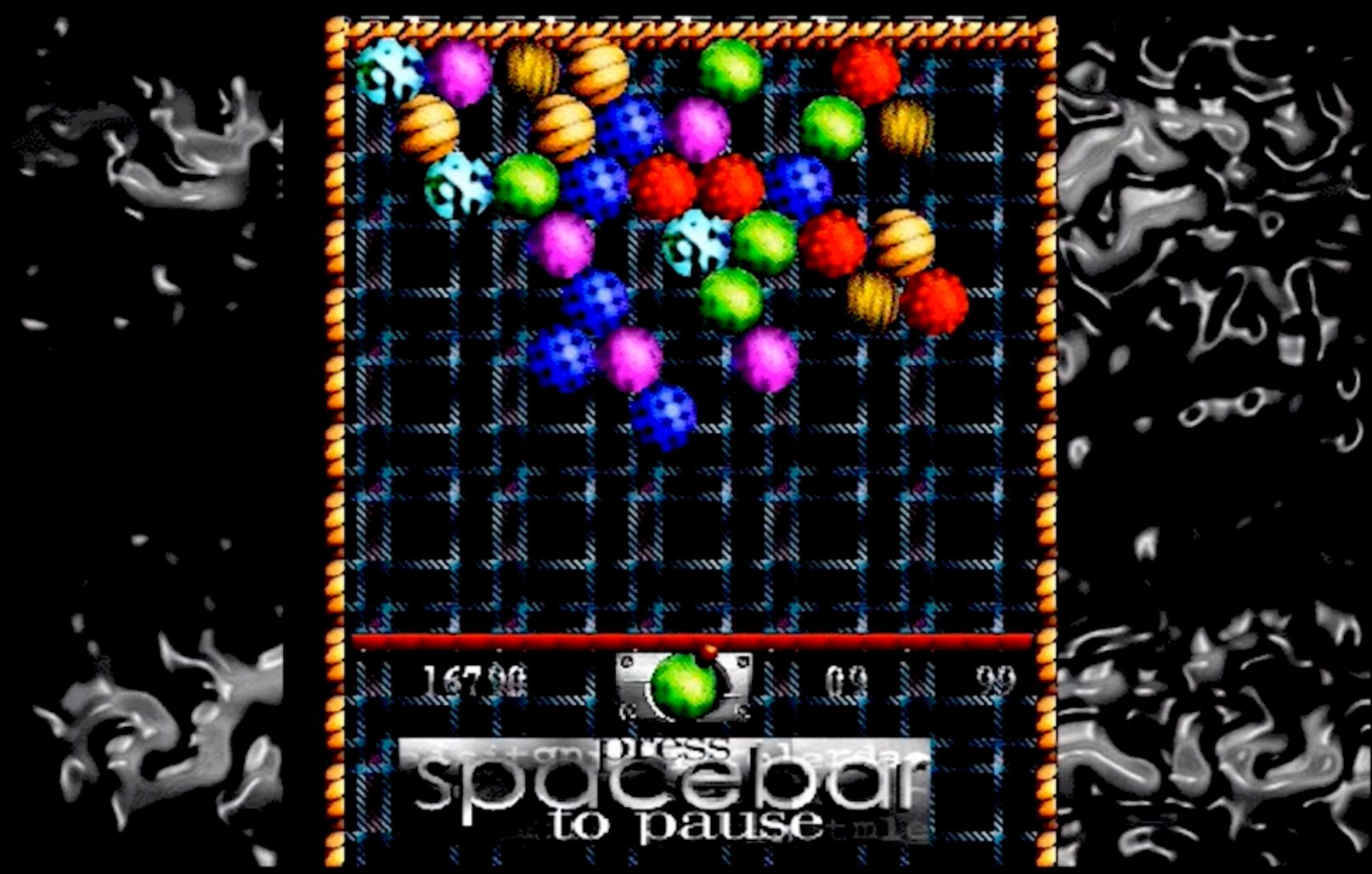
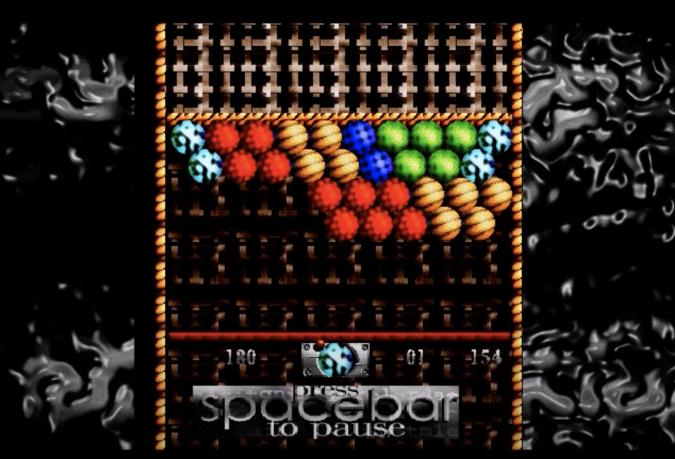
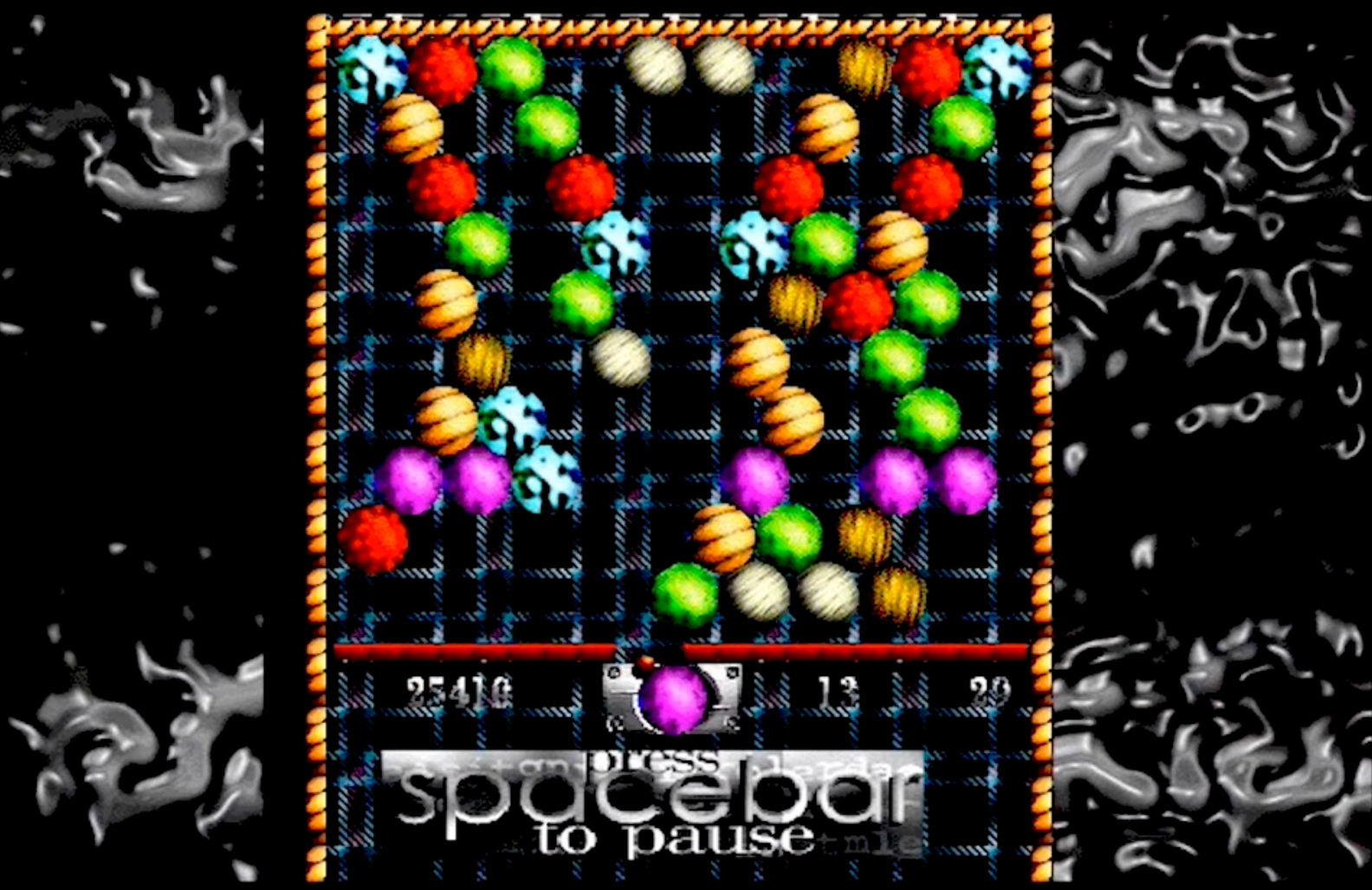
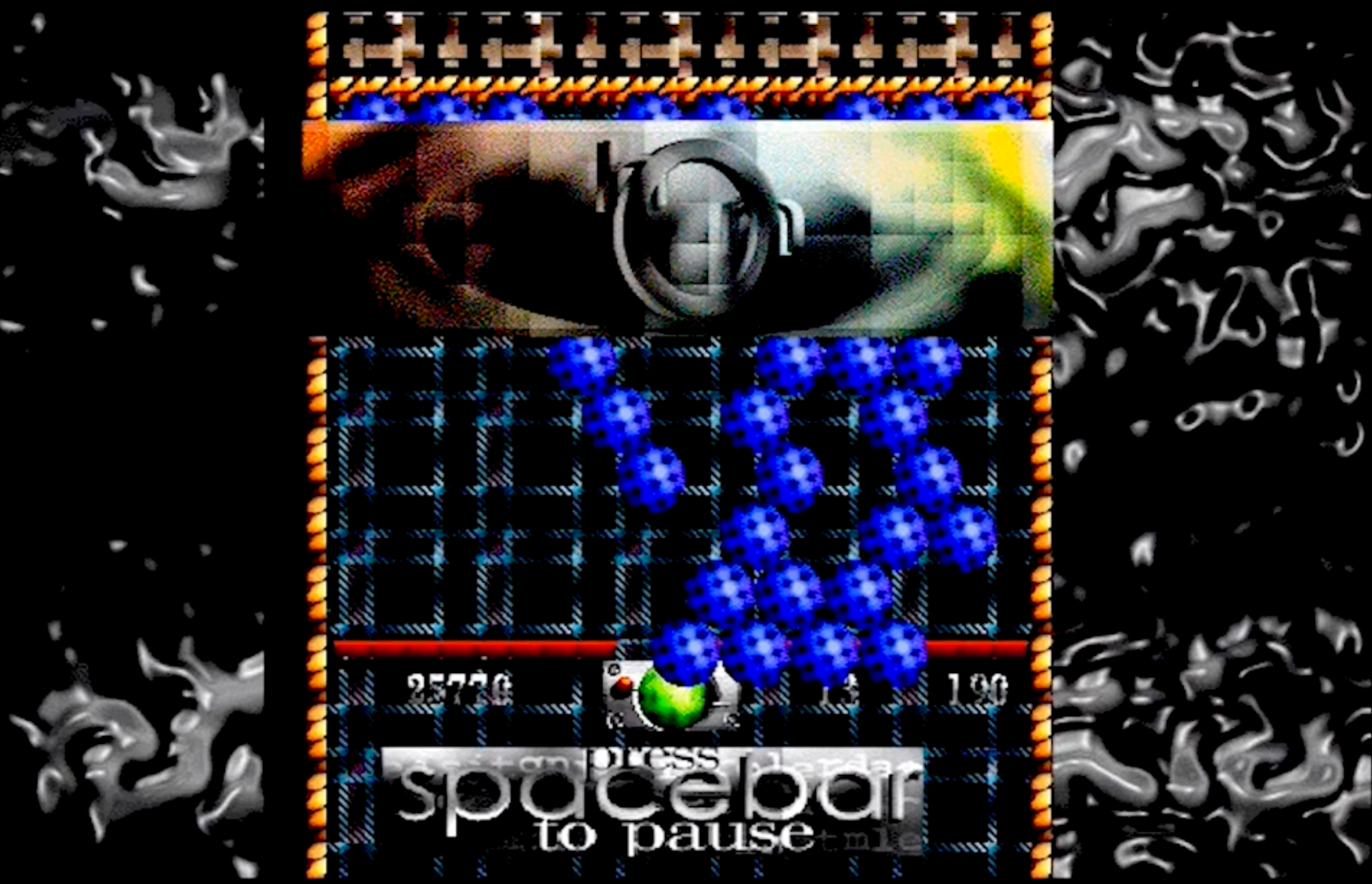
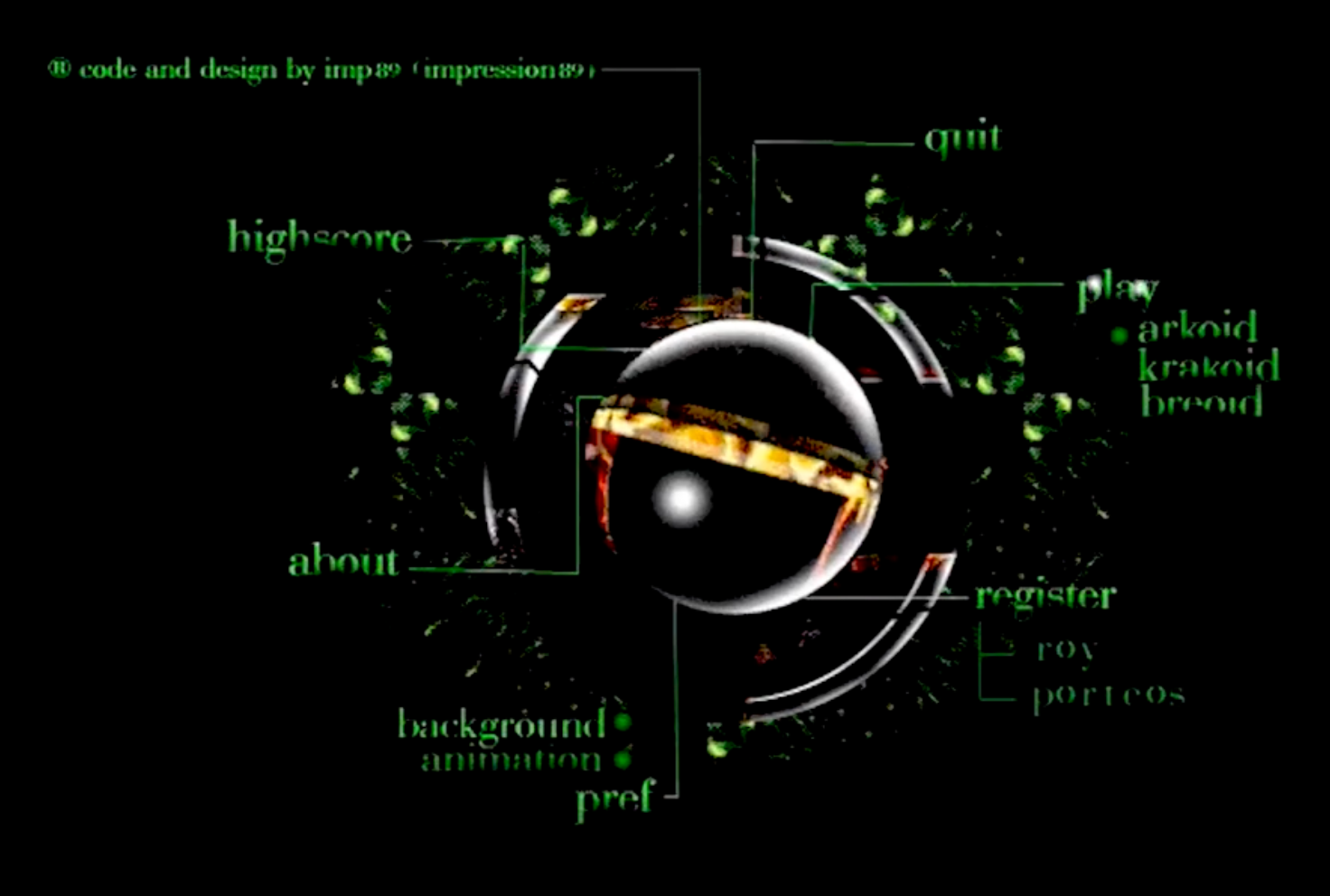
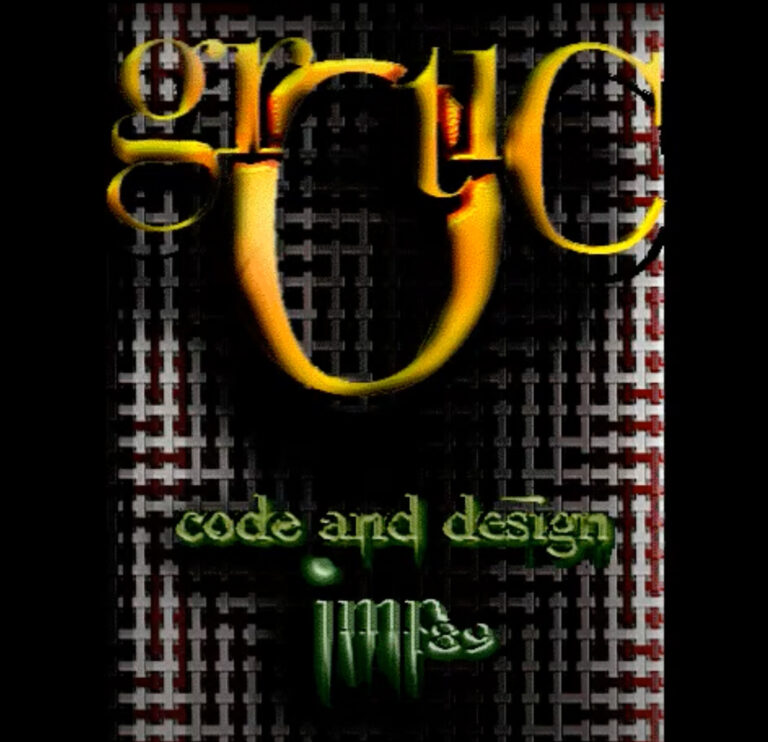
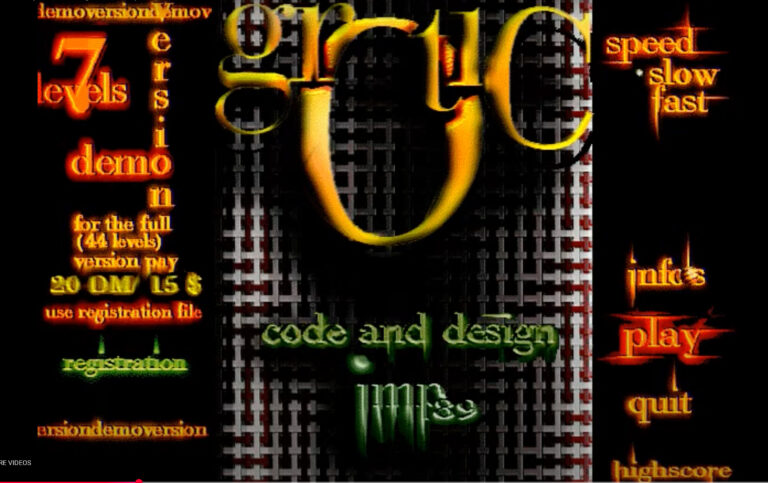
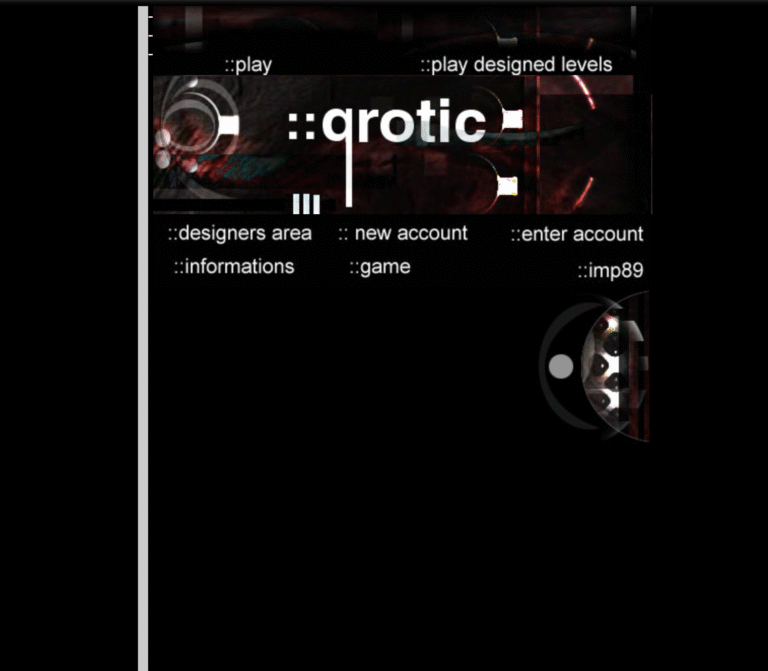
One of the first completed projects from imp89’s MacOS era was GROTIC (1995). The game was inspired by Taito’s 1994 arcade hit, Puzzle Bobble. imp89 derived the name from the fonts “ROTIC” and “GOTIC” used in the game, as typefaces and typography were always important design elements for him. GROTIC used 100% of Puzzle Bobble’s game mechanics, but it did not adopt the presentation style of the Japanese puzzle game.
The game was stripped down to its core mechanics. And those are quite simple. A ball is launched upward at an angle from the bottom edge. The ball flies upward and, upon collision, settles into the next available spot on the grid (a hexagonal grid). The game then determines how many identical tiles are adjacent to that position. If there are three or more identical tiles, they are cleared. If a ball is then suspended freely in the air and isn’t touching the edge or other balls, that tile also disappears. Once all tiles have been removed from the level, the level is complete.
However, the challenge becomes more difficult because the tiles are pushed down a row relatively frequently. You lose if the tiles extend beyond the bottom edge.
The balls or stones are designed like icons. This clearly illustrates the new visual possibilities that opened up at the time with the Mac and innovative software like Kai’s Power Tools (1992). Like many Imp89 games, GROTIC made use of Kai’s Power Tools, employing the Photoshop plugins primarily for texture generation and extrusion. A “software-iconic turn” was taking shape, which made desktops, files, and folders appear much more three-dimensional on the screen. They were no longer just simple text representations. This also had an impact on games. Imp89: “The icon design had to stand out. [It had to] show what the game was about and [could] thereby steer the semiosis.” (Bauer 2025d) The challenge was to achieve a simultaneous and unique differentiation that everyone could understand culturally.
In GROTIC, the icons set the stage for the game. And although the game wasn’t in 3D, it consisted of hand-rendered 3D icons. A game like GROTIC made it clear through its icons that it was a “hand-rendered” game. And to ensure the whole package was cohesive, the same icons were used for the storage media—first for floppy disks, then for the new medium of the CD-ROM, where the game icon took on great significance (ibid.).
The game was offered online as shareware and sold reasonably well, with 200–400 copies sold in the two or three years following its release. Several versions were released, all of which were distributed as shareware; later, they were also made available on CD-ROMs as part of shareware collections, and much later via MacUpdate.com. This was between 1995 and 1998. Imp89 recalls that there were also contracts for shareware distribution, for example with Softdisk Publishing in Louisiana and the distribution company Kagi in Berkeley. A cracked version of GROTIC also existed, as well as a serial number included in a “serial number collection.” (see:
https://www.gamelab.ch/?p=12699 and ResearchBlog Swiss Digitization:
https://research.swissdigitization.ch/?p=6454 )