Blupi à la maison
Blupi is an iconic video game character from the Swiss Smaky computer, designed and marketed by the Swiss company Epsitec. Blupi à la maison is the first game, centered entirely around the Blupi character. It was released in 1988 for the Smaky computer (under the name Toto à la maison) and was later ported to DOS (1995) and Windows (1999) operating systems. Today, the Smaky/DOS version can be played via emulators (https://www.playdosgames.com/online/blupi-at-home/).
Blupi was originally named Toto; for the international market, the character was renamed Blupi, and later, for English-speaking regions, Eggbert. The character was created as early as 1974 by Daniel Roux in the comic La Guerre des Blup (https://blupi.org/download/ark/la_guerre_des_blup_partage.pdf); and from 1979 onward, it was also used to illustrate the Smaky software documentation.
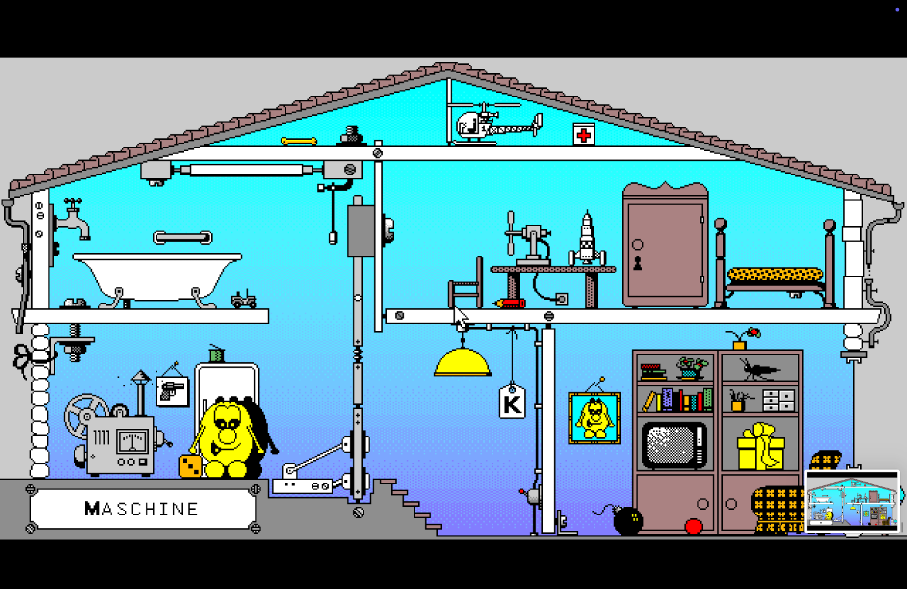
Depicted in a 2D side view, nearly the entire game takes place in Blupi’s house, the home of a tinkerer and toy lover. A small elevator connects the ground floor and the first floor; switches, machines, and toys scattered throughout the house define the atmosphere. When the player interacts with objects or enters letters or numbers via the keyboard, Blupi performs corresponding actions: Pressing A sends him into space as an astronaut; pressing B has him take a bath; pressing R gives him an X-ray from Doctor Blupi. There are unique animations for all 26 letters, as well as various playable mini-games.
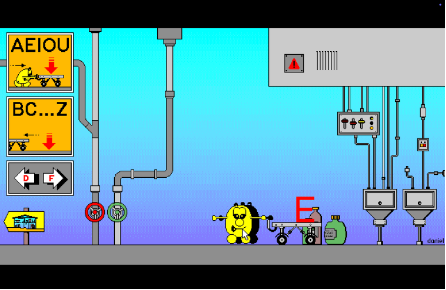
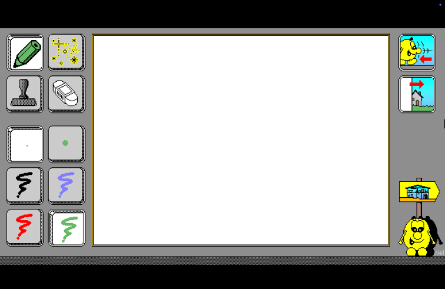
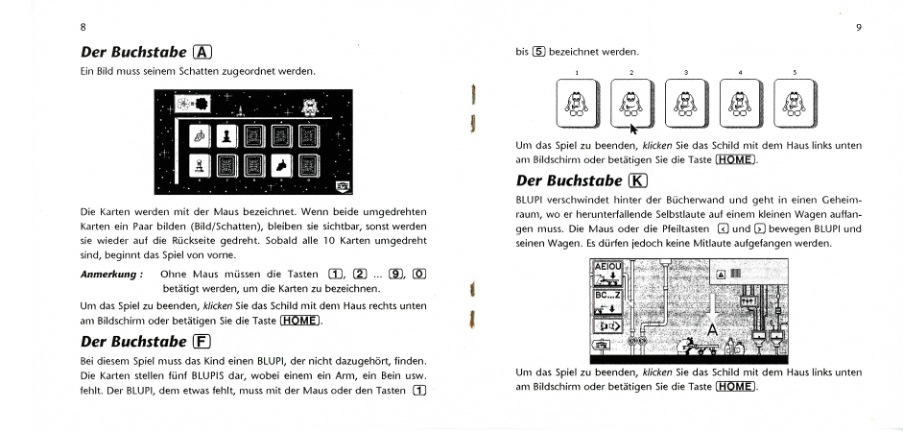
These include, among other things, several variations of memory games—with identical images or letters, with pairs of images related by content, or with matching shapes. In K, Blupi goes behind the library into a secret room where falling vowels must be caught. To do this, he pushes a small cart controlled with the mouse and arrow keys; consonants must be deliberately dropped (see instructions in the manual). Pressing Z (Zigzag) opens a drawing program that offers four colors and 25 stamps in the Smaky/DOS version (Windows version: seven colors and ten stamps). For further differences in the interface and game mechanics, see https://blupi.fandom.com/wiki/Blupi_at_Home.
If you enter any number on the keyboard, Blupi takes you to the basement, where you have to solve number puzzles. Teacher Blupi holds up a blackboard with a number on it; the player then clicks on the matching number or the number of dots. A charming detail (which is missing from the Windows version): In the basement, there’s a Smaky computer—next to a bathtub.
The animations are humorous and accompanied by appropriate sounds and beeps. If the player enters the wrong answer, Blupi shakes his head, falls to the ground, or gets struck by lightning; if the answer is correct, he jumps for joy or takes off like a helicopter.
Blupi à la maison is a simple, playful learning environment with minigames and, at the same time, the first in a series of more than 10 increasingly complex Blupi games. In its aesthetics—the 2D side view, the domestic architecture—as well as in the interactive logic involving a whimsical householder, it strongly resembles Little Computer People (1985) and was likely inspired by it.