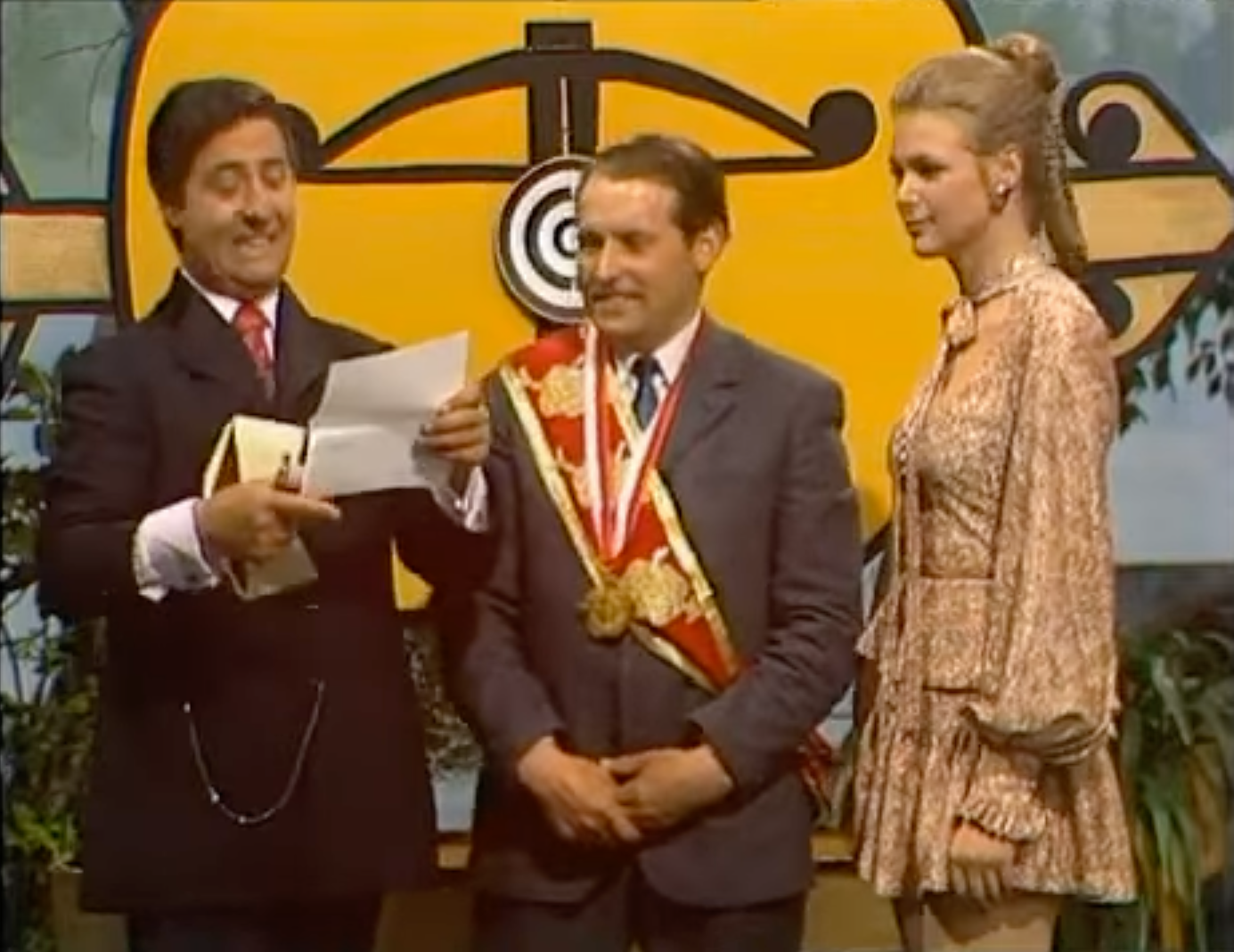
Der Goldene Schuss
Starting in the late 1950s, more and more electromechanical arcade games began to appear. They were all based on mechanics and electricity, with the first pinball machines leading the way. Notable games included Shoot the Bear (1950), Arizona (1960)—an air rifle target game—Monopoly (1968)—a soccer game featuring motorcycles—Stunt Pilot (1971)—a flying game—and Wild Gun (1974)—a film-based duel arcade game from Nintendo.
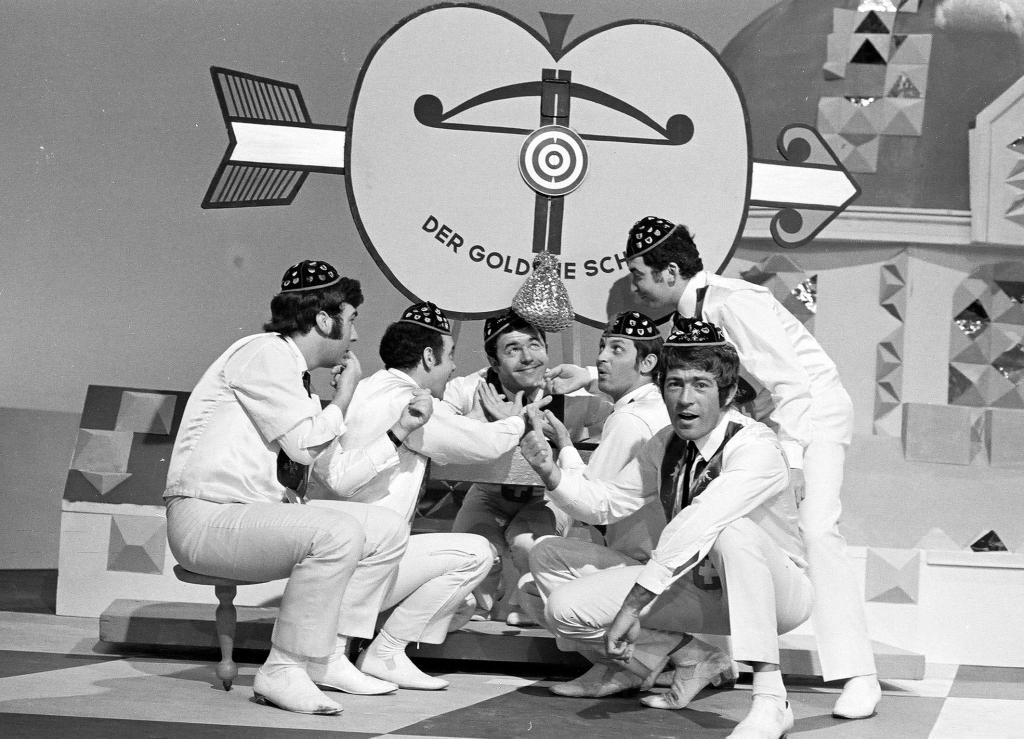
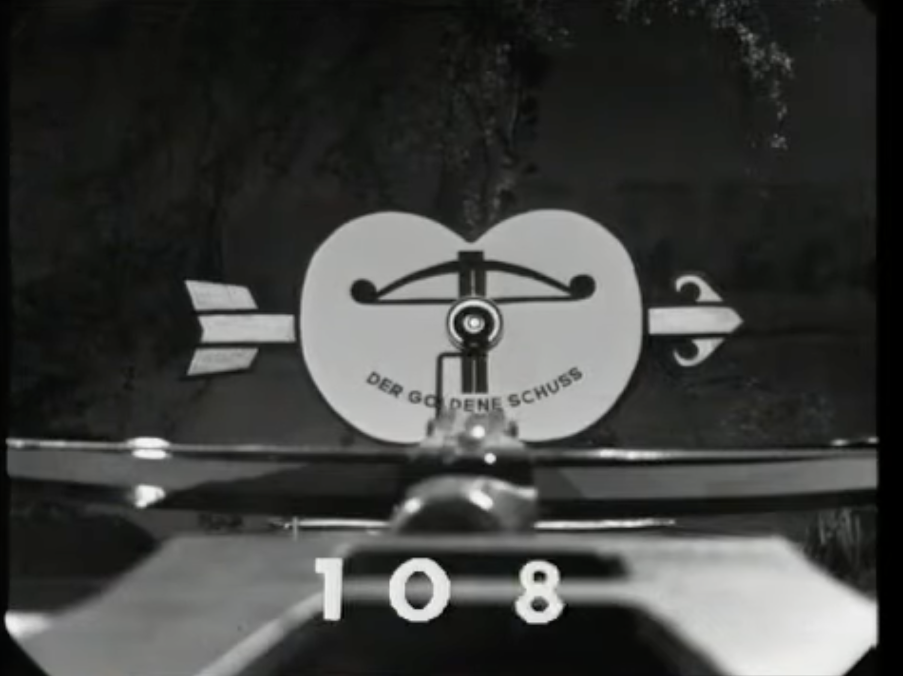
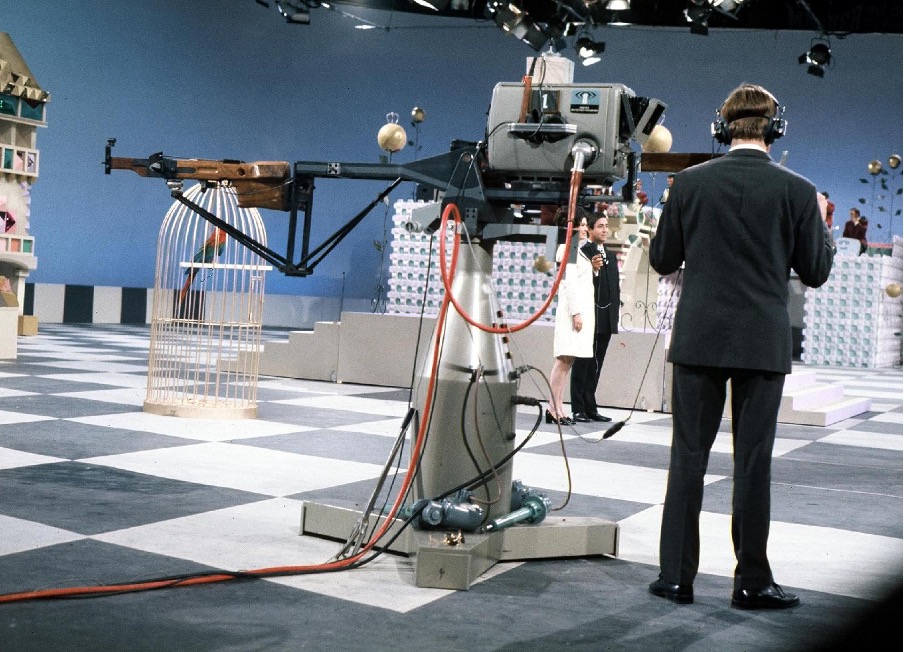
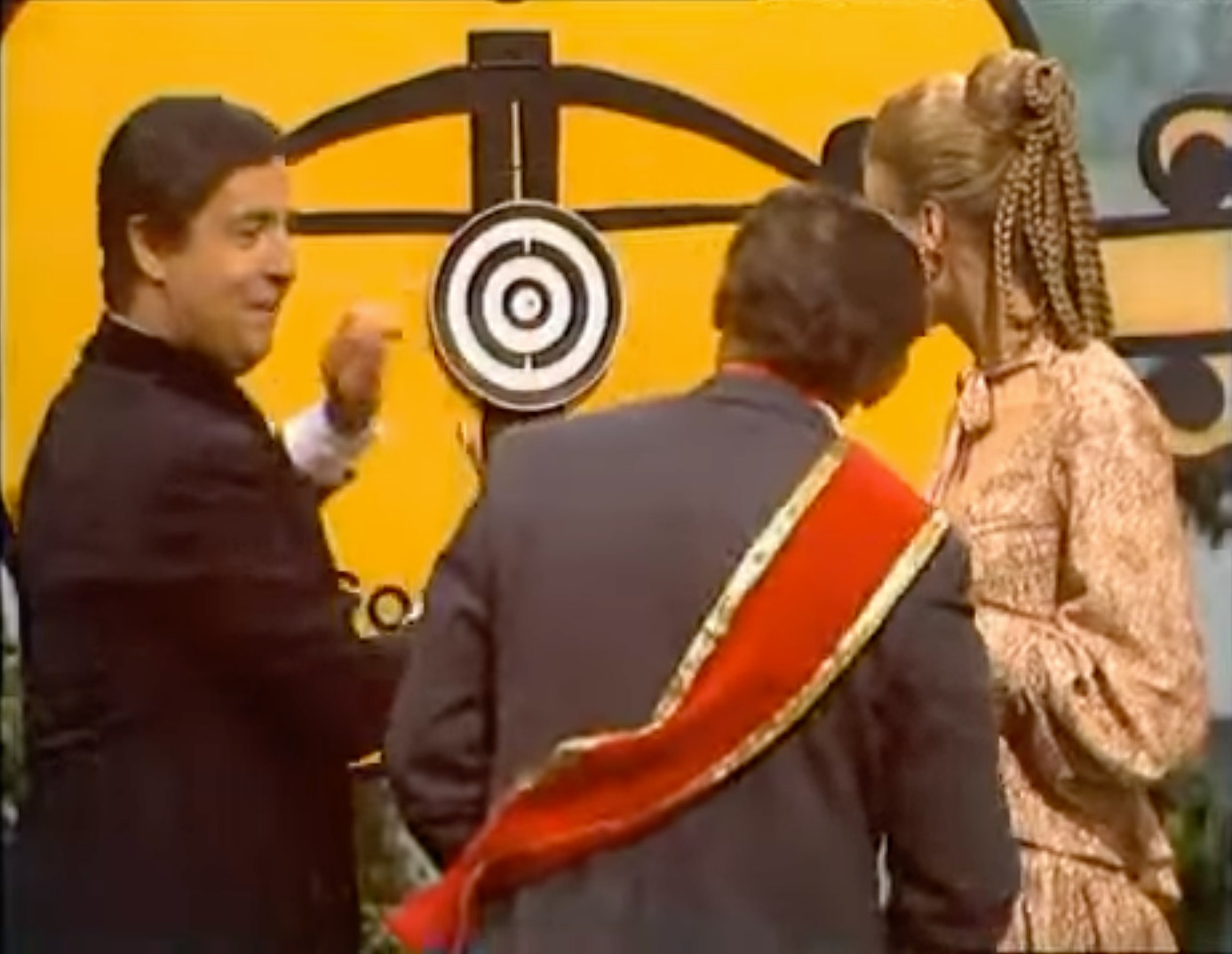
Television, as a mass medium, also experimented with this new type of game in its early days. This included later audience-participation games like “Lautstärke-Pong” on ZDF’s “Telespiele” with Gottschalk, as well as the first interactive show in Europe featuring a television-based electromechanical shooting game: “Der goldene Schuss” (The Golden Shot) from 1964 on ZDF, created by the Swiss musician (Geschwister Schmid) and producer Werner Schmid. This game show features various rounds to determine the finalist. Unlike arcade games, the final round is rooted in the educated middle class and is based on the apple-shooting scene from Schiller’s “Wilhelm Tell.” Here, one sees a giant apple cut in half and a target. The goal is to shoot a string in the center of the target, from which a bag containing 8,000 marks hangs. The metaphor: the “prize” literally hangs by this “silk thread.” The television screen shows the shooter’s* first-person perspective. This is the camera view of the moving crossbow mounted on a tripod. This clarifies the apple-shooting situation, and every viewer* now has the shooter’s—or “Tell’s”—perspective. It is a radically different perspective than the one typically conveyed in images or films depicting this scene.
The selected audience member* can “control” the operator via the phone using the voice commands “left,” “right,” “higher,” “lower,” and “stop.” The operator, who is blindfolded, executes these commands using a crossbow joystick. If the TV player* is confident they can hit the center (there is a time limit), they trigger the arrow via the operator with the voice command “shoot,” and in the best-case scenario, the arrow hits the string and the bag falls to the ground. The game is won, “the young Tell is saved.” In this television game, the studio setting serves as both a single-player and mass display; the voice and the telephone serve as input devices; the game mechanics themselves are processed by the operator and executed via physics on the crossbow and the apple. In other words, the game is mediated through human-technical means—a kind of television-telephone-human-electromechanical-arcade.
The game show was very popular and ran continuously from 1964 to 1970. In the 1990s, similar experiments were conducted using the inputs from new push-button telephones.
See also:
ElectroMechanicalArcades – gaming worlds overtaken by electronics (from 1972 onward). https://www.gamelab.ch/?p=448.
Television games – TV as an output device (display) and the telephone as an input device. https://www.gamelab.ch/?p=9101